What Counts as Spoliation of Employment Records

You filed a complaint with the EEOC. Three months later, your employer produced a thin stack of documents—and claims that's everything they have on you.
No performance reviews from the past two years. No disciplinary write-ups. No emails about your reassignment.
You know those records existed. You saw them. You signed some of them.
Here's what you need to understand: When employers destroy or "lose" records after litigation starts, federal courts have the power to tell the jury that those missing records probably would have helped your case.
The Duty to Preserve Evidence Begins Before Lawsuit Filing

Most people assume employers only have to keep records once you file in federal court.
That's wrong.
In Zubulake v. UBS Warburg LLC, 220 F.R.D. 212 (S.D.N.Y. 2003), the Southern District of New York held that the duty to preserve evidence arises when a party reasonably anticipates litigation.
The moment your employer knows a lawsuit is likely—when you file an EEOC charge, send a formal complaint to HR, or hire an attorney who contacts them—they must suspend their routine document-destruction policies for anything related to your employment.
This is called a litigation hold.
The court in Zubulake explained that once the duty to preserve arises, the employer must issue clear instructions to employees who possess relevant documents: stop deleting emails, stop shredding personnel files, stop overwriting backup tapes.
Federal Regulations Already Require Employers to Keep Specific Records
Even before you file any complaint, federal law imposes independent record-retention requirements on employers.
Under 29 CFR §516.2, employers covered by the Fair Labor Standards Act must maintain payroll records, timecards, and wage-rate tables for at least three years.
Under 29 CFR §1910.1030(g)(2)(vii), employers must keep training records related to bloodborne pathogens for the duration of employment plus three years.
These aren't optional. They're regulatory mandates with their own enforcement mechanisms.
When an employer also faces a litigation hold, the two obligations stack: they can't destroy records because of the regulatory retention period and they can't destroy records because litigation is reasonably anticipated.
Here's the thing:
Violating the regulatory retention schedule is itself evidence of bad faith—even if the employer claims the destruction was "routine" or accidental.
The Four-Part Test for Spoliation Sanctions
When you move for sanctions based on destroyed records, courts typically apply a four-element framework.
In Skidmore v. Precision Printing & Packaging, Inc., 188 F.3d 606 (5th Cir. 1999), the Fifth Circuit held that an adverse-inference instruction is appropriate when:
- The evidence was within the party's control—the employer possessed or had custody of the records.
- There was a duty to preserve—litigation was reasonably anticipated or a regulatory obligation existed.
- The evidence was destroyed with a culpable state of mind—ranging from negligence to intentional bad faith.
- The destroyed evidence was relevant—it bore on the claims or defenses in the case.
You have to prove all four.
But notice what you don't have to prove: that the missing records would definitely have supported your case. Courts don't require you to reconstruct the content of documents that no longer exist.
The relevance prong is satisfied if the records plausibly relate to a contested issue—like whether your supervisor knew about your protected activity, or whether your job performance really declined.
Culpable State of Mind: From Negligence to Bad Faith

The third element—culpable state of mind—exists on a spectrum.
At one end: negligence. The employer knew it had a duty to preserve, but failed to implement a proper litigation hold. IT kept running the auto-delete script. HR kept purging old performance reviews.
In the middle: gross negligence or recklessness. The employer's attorney sent a litigation-hold memo, but nobody followed up. Relevant employees never got the memo. No one checked whether preservation actually happened.
At the far end: intentional destruction or bad faith. The supervisor orders a subordinate to "clean out the files" the week after the EEOC charge arrives. Emails are deleted even though counsel explicitly instructed preservation.
Courts calibrate the severity of sanctions to the severity of the misconduct.
Now, here's where it gets interesting:
Under Federal Rule of Civil Procedure 37(e)—amended in 2015—courts can impose any sanction (including adverse-inference instructions, evidence preclusion, or even default judgment) if the destruction was done with intent to deprive another party of the evidence's use in litigation.
For lesser levels of culpability, courts can still impose sanctions, but only if you demonstrate prejudice—that the missing evidence harmed your ability to prove your case.
What "Adverse Inference" Actually Means at Trial
An adverse-inference instruction is the most common sanction for spoliation.
Here's what it looks like in practice:
The judge tells the jury—in formal jury instructions at the close of evidence—that they may (and in some circuits must) presume that the destroyed records would have been unfavorable to the employer.
Imagine you're alleging your supervisor retaliated against you for filing an OSHA complaint. Your supervisor's emails from the relevant two-month period are missing. The employer claims the emails were "auto-deleted" and can't be recovered.
With an adverse-inference instruction, the jury is told:
"You may infer that the missing emails contained evidence harmful to the defendant's case—for example, that the supervisor discussed the plaintiff's OSHA complaint or expressed animus toward the plaintiff for filing it."
That's huge.
It shifts the burden. The employer now has to overcome a jury instruction that assumes the missing evidence was bad for them.
In retaliation cases, where knowledge and motive are often the contested issues, adverse-inference instructions can be outcome-determinative. The jury doesn't need smoking-gun evidence if the court has already told them to infer that the missing records were the smoking gun.
Other Sanctions Courts Can Impose
Adverse-inference instructions aren't the only remedy.
Depending on the severity of the misconduct and the prejudice to your case, courts can also:
- Preclude the employer from introducing certain evidence—for example, blocking the employer from offering its own reconstructed timeline if it destroyed the original records that would have allowed you to challenge that timeline.
- Award monetary sanctions—requiring the employer to pay your attorney's fees and costs associated with investigating and litigating the spoliation issue.
- Strike pleadings or defenses—removing the employer's affirmative defenses if those defenses depend on destroyed evidence.
- Enter default judgment—in extreme cases of intentional, bad-faith destruction, courts can rule in your favor on liability without a trial.
Default judgment is rare. Courts reserve it for cases where the destruction was so egregious that no lesser sanction can cure the prejudice.
But it gets better:
Even short of default, the process of litigating a spoliation motion generates discovery. You can depose the IT director about the email-retention policy. You can subpoena the outside vendor that managed the backup tapes. You can force the employer to produce the litigation-hold memo—or admit that no hold was ever issued.
That discovery often reveals additional misconduct or inconsistencies that undermine the employer's credibility at trial.
The "Records-Universe Closure" Problem
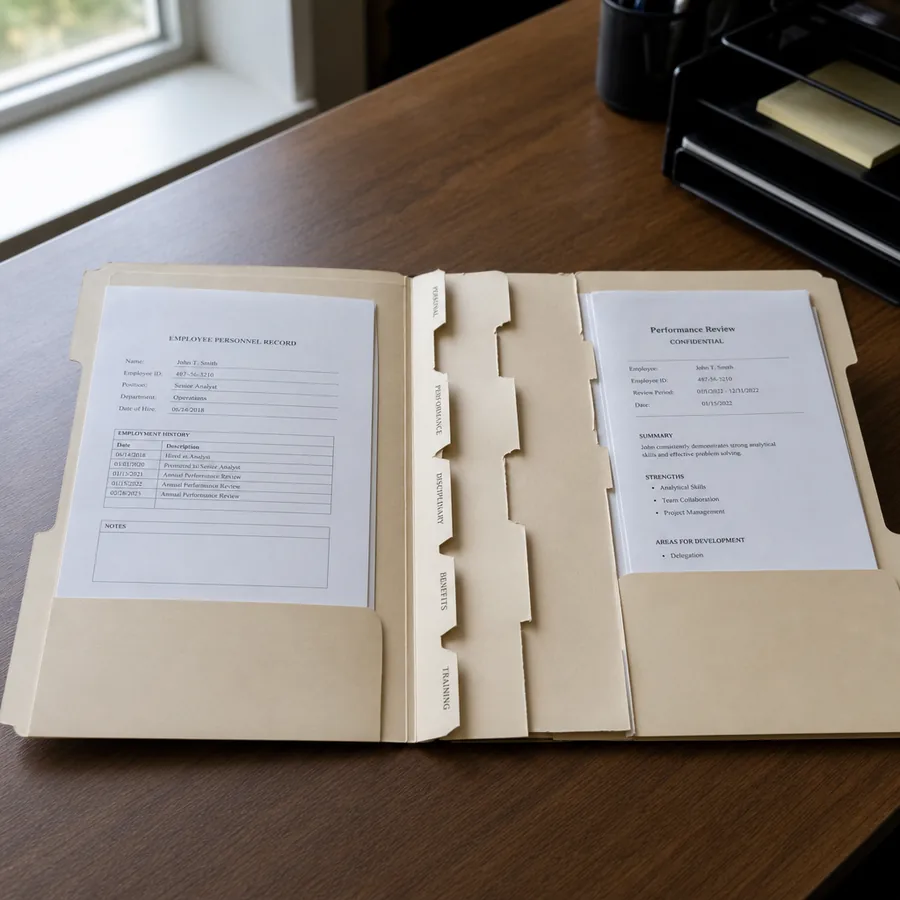
One of the trickiest aspects of spoliation is proving that records existed in the first place.
Employers sometimes claim: "We never had those documents. There's nothing to produce."
How do you prove otherwise?
You look for secondary references—metadata, email threads, meeting minutes, or testimony that confirms the records once existed.
For example: Your supervisor mentions your "written warning from March" in an email, but no written warning appears in the production. That email is evidence the record existed.
Or: The employee handbook states that all performance reviews are documented in writing and stored in personnel files. If your file contains no reviews for a two-year period when you know you received them, the handbook itself creates the inference that reviews existed and were removed.
Courts are skeptical when an employer's production has conspicuous gaps that align suspiciously with the contested period or the adverse employment action.
The Records-Universe Closure Trap explores how employers sometimes try to define the "universe" of relevant records in a way that excludes documents you know exist—forcing you into satellite litigation over the scope of discovery.
How Zubulake Changed Employer Obligations
Before Zubulake v. UBS Warburg LLC, 220 F.R.D. 212 (S.D.N.Y. 2003), many employers treated litigation holds as optional or applied them inconsistently.
Zubulake imposed a clear, enforceable standard:
Once litigation is reasonably anticipated, the employer must (1) issue a written litigation hold to all custodians of potentially relevant documents, (2) communicate the hold in clear terms so employees understand what must be preserved, and (3) monitor compliance to ensure preservation actually happens.
The court also held that in-house or outside counsel has an affirmative duty to ensure the litigation hold is implemented—it's not enough to send a memo and hope for the best.
Failures at any of these steps can support a finding of negligence or gross negligence, even if no one intended to destroy evidence.
Here's the thing:
Zubulake is a district-court opinion, not binding nationwide precedent. But it's been cited and adopted by federal courts across the country. It's become the de facto national standard for preservation duties in employment cases.
Zubulake and the Duty to Preserve in Employment Cases breaks down the decision in detail and traces how courts in different circuits have applied its framework.
When Spoliation Sanctions Are Not Available
Not every missing document supports a spoliation claim.
Courts require you to show that the duty to preserve had already arisen when the destruction occurred.
If records were destroyed in 2018 under a routine retention policy, and you didn't file your EEOC charge until 2021, there's usually no spoliation. The employer had no reason to anticipate litigation in 2018.
(Though if the records fell within a regulatory retention period that hadn't yet expired, the regulatory violation may still matter.)
Similarly, if the missing records are only tangentially related to your claims—say, cafeteria receipts when your case is about a denied promotion—courts won't find them "relevant" under the fourth Skidmore element.
And if you can't show prejudice—if you have other evidence that proves the same facts the missing records would have shown—courts may decline to impose sanctions even if technical spoliation occurred.
The inquiry is always fact-specific.
Why Spoliation Matters So Much in Retaliation Cases
Retaliation claims often turn on questions of knowledge and motive that live in documents.
Did your supervisor know you filed a workers' comp claim before they reassigned you? The email thread would answer that—if it still existed.
Was the "performance improvement plan" that appeared three weeks after your EEOC charge actually based on legitimate concerns, or was it pretextual? The draft versions and internal discussions would show that—if they hadn't been deleted.
When those documents vanish, you lose the ability to prove your case through direct evidence. You're left with circumstantial inferences and witness testimony, much of which the employer can contest or explain away.
Spoliation sanctions level the playing field.
An adverse-inference instruction doesn't give you the documents back, but it gives you the next-best thing: a jury instruction that assumes the missing records would have supported your version of events.
That's why employers take litigation holds seriously (when they do). The risk of an adverse-inference instruction can be more damaging than the underlying merits of the retaliation claim.
Frequently Asked Questions
What if my employer claims the records were "accidentally" deleted?
Accident or negligence can still satisfy the "culpable state of mind" element under Skidmore. Courts have held that negligent failure to preserve—like failing to issue a litigation hold or failing to suspend auto-delete policies—supports spoliation sanctions. Intentional bad faith isn't required, though it increases the severity of sanctions available.
How do I prove that missing records actually existed?
Look for secondary references: emails that mention the document, metadata showing it was created, deposition testimony from witnesses who saw it, or policy manuals that require certain records to be kept. Even circumstantial evidence—like a suspicious gap in an otherwise-complete file—can support an inference that records were removed.
Can I get spoliation sanctions if I never specifically asked for the documents in discovery?
Yes. The duty to preserve isn't triggered by a discovery request—it's triggered by reasonable anticipation of litigation. If the employer had a duty to preserve and destroyed relevant records, sanctions may be available even if you never formally requested them, because the employer's duty existed independent of your requests.
What's the difference between an adverse-inference instruction and default judgment?
An adverse-inference instruction allows the jury to presume the missing evidence was unfavorable to the employer, but the employer can still present other evidence and argue its case. Default judgment ends the case on liability—the court rules in your favor without a trial. Default is reserved for the most egregious spoliation, where lesser sanctions can't remedy the prejudice.
Do state employment laws have different spoliation rules?
Some do. While Federal Rule of Civil Procedure 37(e) and cases like Zubulake apply in federal court, state courts may have their own evidence codes and common-law spoliation doctrines. If your retaliation case is proceeding under state law in state court, the standards and available sanctions may differ. The federal framework described here applies to cases in federal court or removed to federal court.