Zubulake and the Duty to Preserve in Employment Cases
You filed an EEOC charge alleging retaliation. Three weeks later, you requested your personnel file—and got eight pages instead of the complete record you know existed.
You're not imagining it. Courts have held employers to strict preservation obligations once litigation becomes reasonably foreseeable. And when employers let critical records "disappear," the consequences can be severe.
When the Duty to Preserve Evidence Arises
The clock starts ticking the moment litigation becomes "reasonably foreseeable."
In Zubulake v. UBS Warburg LLC, 220 F.R.D. 212 (S.D.N.Y. 2003), the court held that employers must suspend routine document-destruction policies and issue a litigation hold once they reasonably anticipate litigation. That doesn't mean you need to file a lawsuit first. The duty typically arises when an employee files an internal complaint, submits an EEOC charge, or sends a demand letter from counsel.
Once that trigger occurs, the employer must identify and preserve all documents—paper and electronic—relevant to the anticipated claims.
What does "reasonably foreseeable" look like in practice?
Courts have found the duty triggered by an EEOC charge filing, a written complaint to HR alleging unlawful discrimination, or even verbal notice of intent to consult an attorney. If the employer's own counsel advised them to "document everything" or "hold onto records," that's often proof the employer itself anticipated litigation.
The Litigation-Hold Requirement
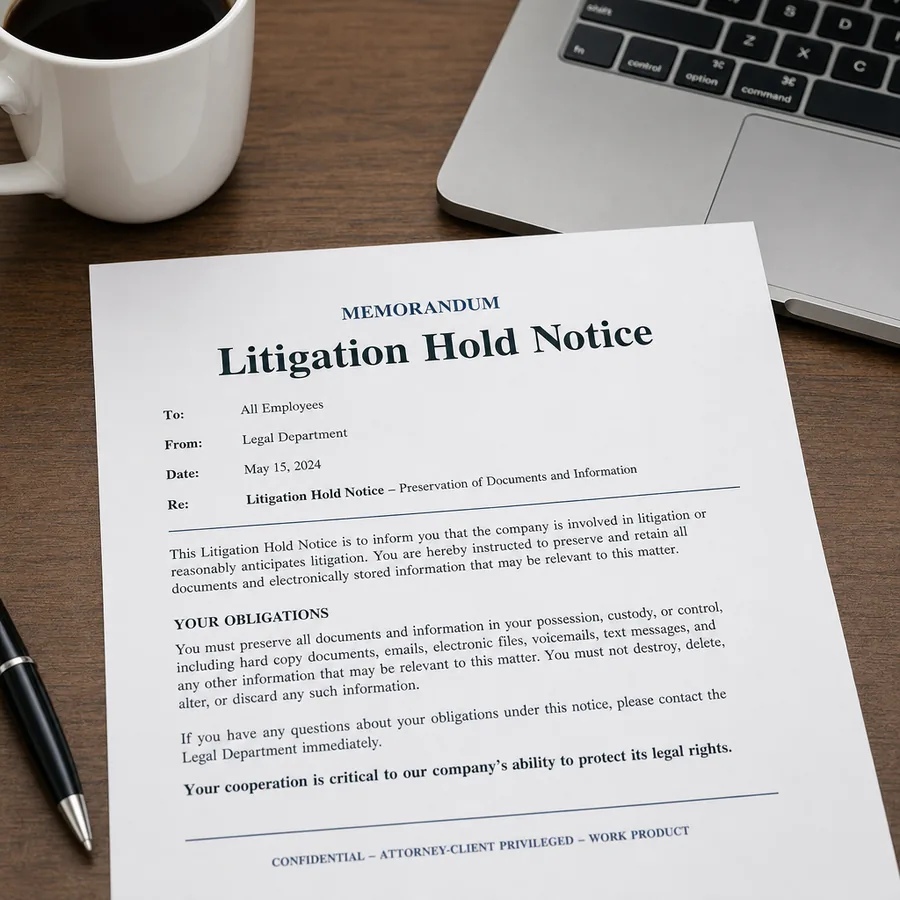
Once the duty to preserve kicks in, the employer must issue what courts call a "litigation hold."
This isn't optional. Zubulake made clear that counsel must take affirmative steps to ensure potentially relevant documents are identified, located, and preserved. That includes suspending auto-delete policies in email systems, instructing IT to disable retention rules, and notifying key custodians—HR, supervisors, payroll—that records must not be destroyed.
Here's the thing: a half-hearted instruction to "save relevant emails" doesn't cut it.
Courts expect the litigation hold to be specific. Who are the custodians? What types of records are in scope? What systems need retention rules suspended? The hold must be memorialized in writing, distributed to all relevant personnel, and periodically re-issued to ensure compliance.
In Zubulake, the employer's failure to issue a timely litigation hold resulted in the loss of backup tapes containing critical emails. The court noted that counsel's obligation extends beyond sending a single memo—counsel must oversee compliance, interview custodians, and verify that relevant systems have been flagged.
What Records Must Be Preserved?

The duty extends to all documents and data "relevant" to the claims or defenses.
That's broader than you might think. It includes not just the plaintiff's own personnel file, but also comparator records, emails discussing the plaintiff's performance or complaints, calendar entries showing meetings about the employee, texts between supervisors, and drafts of write-ups or termination memos.
Electronic records carry the same preservation duty as paper. Emails, Slack messages, metadata showing when a document was created or edited, and even deleted items still residing on backup servers fall within scope.
Now, here's where it gets interesting: federal regulations independently require employers to retain certain categories of employment records for set periods, regardless of litigation.
For example, the Fair Labor Standards Act requires wage-and-hour records to be kept for three years under 29 CFR §516.2. OSHA bloodborne-pathogen training records must be retained for three years under 29 CFR §1910.1030(g)(2)(vii). When those regulatory records are missing, courts may infer that their contents would have been unfavorable to the employer—even if the employer claims the destruction was "routine."
The Four-Part Test for Adverse-Inference Instructions
When relevant records go missing, courts apply a structured test to determine whether sanctions are warranted.
The framework from Zubulake and cases like Skidmore v. Precision Printing & Packaging, Inc., 188 F.3d 606 (5th Cir. 1999), requires the moving party to prove four elements:
1. Control: The missing evidence was within the spoliating party's control.
This element is almost always satisfied in employment cases. The employer controls its own HR files, email systems, and document-retention policies.
2. Duty to preserve: A duty to preserve the evidence existed.
As discussed above, this duty arises when litigation is reasonably foreseeable. In Skidmore, the court held that the duty attached the moment the plaintiff filed his EEOC charge. Any destruction of personnel records after that point violated the preservation obligation.
3. Culpable state of mind: The evidence was destroyed with a culpable mental state.
Courts recognize a spectrum of culpability, from negligence to intentional destruction. Intentional destruction in bad faith typically warrants the harshest sanctions, including terminating sanctions or default judgment. But even negligent destruction—such as failing to suspend an auto-delete policy—can support an adverse-inference instruction.
4. Relevance: The destroyed evidence was relevant to the claims or defenses.
The moving party need not prove precisely what the missing records would have shown. Courts infer relevance from the fact that the spoliating party chose to destroy evidence it knew might be needed.
What Sanctions Can Courts Impose?
The consequences for spoliation range from monetary penalties to case-dispositive sanctions.
The most common remedy is an adverse-inference instruction. The court tells the jury: "You may—but are not required to—infer that the missing evidence would have been unfavorable to the employer." In retaliation cases, where the plaintiff must prove that protected activity was a "but-for" cause of the adverse action, an adverse inference on causation can be outcome-determinative.
But it gets better: courts can also preclude the employer from introducing certain defenses or testimony if those defenses rely on the very records the employer failed to preserve.
In extreme cases—where the destruction was willful and in bad faith—courts have entered default judgment or dismissal under Federal Rule of Civil Procedure 37(e)(2). This effectively ends the case without trial.
Monetary sanctions are also available. Courts can shift e-discovery costs, award attorney's fees incurred in litigating the spoliation motion, or impose fines payable to the court.
How the 2015 Amendments to Rule 37(e) Changed the Landscape
In 2015, the Federal Rules of Civil Procedure were amended to address spoliation of electronically stored information (ESI).
Rule 37(e) now provides that sanctions are available only if the moving party shows prejudice from the loss and the spoliating party "acted with the intent to deprive another party of the information's use in the litigation."
This raised the bar for the most severe sanctions—terminating sanctions and adverse-inference instructions now require proof of intent to deprive, not mere negligence.
However, lesser sanctions—such as cost-shifting, additional discovery, or curative jury instructions—remain available upon a showing of prejudice, even without proof of intent.
The key distinction: if you can show the employer intentionally destroyed evidence to keep it out of your hands, the full arsenal of sanctions remains on the table. If the destruction was merely negligent, you may still obtain meaningful relief, but an adverse-inference instruction will be harder to secure post-2015.
Connecting Spoliation to Regulatory Record-Retention Violations
Many federal employment statutes impose independent record-keeping obligations.
The Fair Labor Standards Act, OSHA regulations, and the Equal Pay Act all require specific records to be retained for set periods. When those records are missing, courts may treat the regulatory violation as evidence of the employer's culpable state of mind.
For example, if an employer destroyed payroll records that the FLSA required it to retain for three years, a court may infer that the employer knew those records would have been harmful and destroyed them to avoid disclosure.
This dovetails with the Zubulake framework: the regulatory duty to preserve independently satisfies the "duty" prong, and the willful violation of that duty supports a finding of culpability.
For more on how courts scrutinize the production process itself, see When Personnel-File Production Becomes Evidence Against the Employer.
Proving Spoliation in Practice

How do you prove that records existed and were destroyed?
Start with the employer's own policies. Employee handbooks, HR manuals, and document-retention schedules often specify what records are created and how long they're kept. If the policy says performance reviews are documented annually, but none appear in your file, that gap is evidence of spoliation.
Depositions are critical. Ask the HR director: "What happened to the emails between you and the supervisor in the two weeks before my termination?" Ask IT: "When was the litigation hold issued, and which custodians were notified?" Ask counsel: "Did you interview custodians to confirm compliance with the hold?"
Metadata can reveal alterations. If a termination memo was supposedly drafted two weeks before your firing, but the PDF's metadata shows it was created the day before production, that's evidence of post-hoc fabrication. (For more on metadata as evidence of tampering, see When Personnel-File Production Becomes Evidence Against the Employer.)
Witness testimony helps. Co-workers may recall emails or meetings that aren't reflected in the record. Comparator evidence—showing that similarly situated employees have fuller personnel files—can demonstrate selective destruction.
The Relationship Between Spoliation and the Business-Records Exception
Spoliation intersects with evidentiary doctrine in important ways.
Under Federal Rule of Evidence 803(6), business records are admissible if they were made in the regular course of business. But when an employer has destroyed records it was required to keep, courts may exclude the employer's other business records on the ground that the absence of the required records undermines the reliability of the entire recordkeeping system.
This doctrine—rooted in Palmer v. Hoffman—holds that records prepared in anticipation of litigation or with a motive to create self-serving evidence don't qualify as routine business records.
So if an employer destroyed performance reviews but offers a post-termination memo justifying the discharge, you can challenge the memo's admissibility on two grounds: (1) spoliation of the contemporaneous reviews, and (2) the memo was created for litigation, not in the regular course of business.
For a deeper look at how courts apply Palmer to employment records, see Palmer v. Hoffman and the Business-Records Exception.
Frequently Asked Questions
What is the "duty to preserve" in employment litigation?
The duty to preserve is a legal obligation that arises when a party reasonably anticipates litigation. In employment cases, this typically occurs when an employee files an EEOC charge, submits an internal complaint, or provides other notice that litigation is likely. Once the duty attaches, the employer must suspend routine document-destruction policies and issue a litigation hold to ensure relevant records are not destroyed.
What is a litigation hold?
A litigation hold is a written directive that suspends normal document-retention policies and instructs custodians—such as HR, supervisors, and IT staff—to preserve all records relevant to anticipated or pending litigation. Courts expect litigation holds to identify specific custodians, describe the types of records in scope, and be periodically re-issued to ensure compliance.
What is an adverse-inference instruction?
An adverse-inference instruction is a jury instruction that permits (but does not require) the jury to infer that missing or destroyed evidence would have been unfavorable to the party that destroyed it. In retaliation cases, where causation is often the central dispute, an adverse inference on the issue of motive or timing can be case-determinative.
How did the 2015 amendments to Rule 37(e) change spoliation law?
The 2015 amendments raised the bar for the most severe sanctions—such as adverse-inference instructions and terminating sanctions—by requiring proof that the spoliating party acted with intent to deprive the other party of the evidence. However, lesser sanctions (cost-shifting, curative instructions, additional discovery) remain available upon a showing of prejudice, even without proof of intent.
Can an employer be sanctioned for failing to preserve text messages or Slack conversations?
Yes. The duty to preserve extends to all electronically stored information (ESI), including texts, instant messages, and chat-platform conversations. If the employer knew or should have known that such communications were relevant and failed to issue a litigation hold covering those platforms, courts can impose spoliation sanctions just as they would for lost emails or paper documents.