Why Photographing Your Onboarding Packet Matters

You just started a new job.
HR hands you a stack of forms—tax withholding, direct deposit, handbook acknowledgment, maybe an arbitration agreement.
You skim, sign, hand them back. Six months later, you file a retaliation complaint. The employer produces a signed arbitration agreement you swear you never saw. Or a non-compete clause that wasn't in the packet you received. Or a handbook page with language that didn't exist on your first day.
Here's what you'll learn in this article:
- How courts distinguish between contemporaneous records and litigation-driven reconstructions
- Why a simple smartphone photo on day one can defeat document fabrication claims later
- What evidentiary standards protect authentic business records—and exclude post-hoc assembly
The Business-Records Exception Requires Regular Practice, Not Litigation Prep
Federal courts apply strict foundational requirements before admitting employer records as evidence.
Under Federal Rule of Evidence 803(6), a business record is admissible hearsay only if it was "made at or near the time" of the event "by someone with knowledge" and "kept in the course of a regularly conducted activity."
The U.S. Supreme Court made clear in Palmer v. Hoffman, 318 U.S. 109 (1943), that records created primarily for litigation purposes fail this test—even when the business routinely creates such records after every incident.
In that case, a railroad company prepared accident reports after each collision. The Court held these reports inadmissible because their primary purpose was building a litigation file, not managing daily operations.
This distinction matters enormously in retaliation cases.
What Happens When the Employer Can't Prove Regular-Course Creation
When an employer produces an onboarding document during litigation, the employee's attorney can challenge its foundation.
The employer must prove:
- The document was created on or near the employee's hire date
- It was created by someone with firsthand knowledge (usually the HR staff member present)
- It was maintained in the ordinary course of the employer's business
- It was the employer's regular practice to create such records at the time of hiring
If the employer fails any element, the document is excluded as hearsay—or admitted only as a party-opponent admission under Rule 801(d)(2)(D).
Here's the thing:
Party-opponent admissions are statements attributed to the employer. The employer can use them only to show that the statement was made, not to prove the truth of what the statement asserts.
That removes the employer's ability to use the document affirmatively while preserving the employee's ability to argue the document's late appearance, suspicious timing, or metadata inconsistencies prove bad faith.
How a Day-One Photo Defeats后-Hoc Insertion Claims
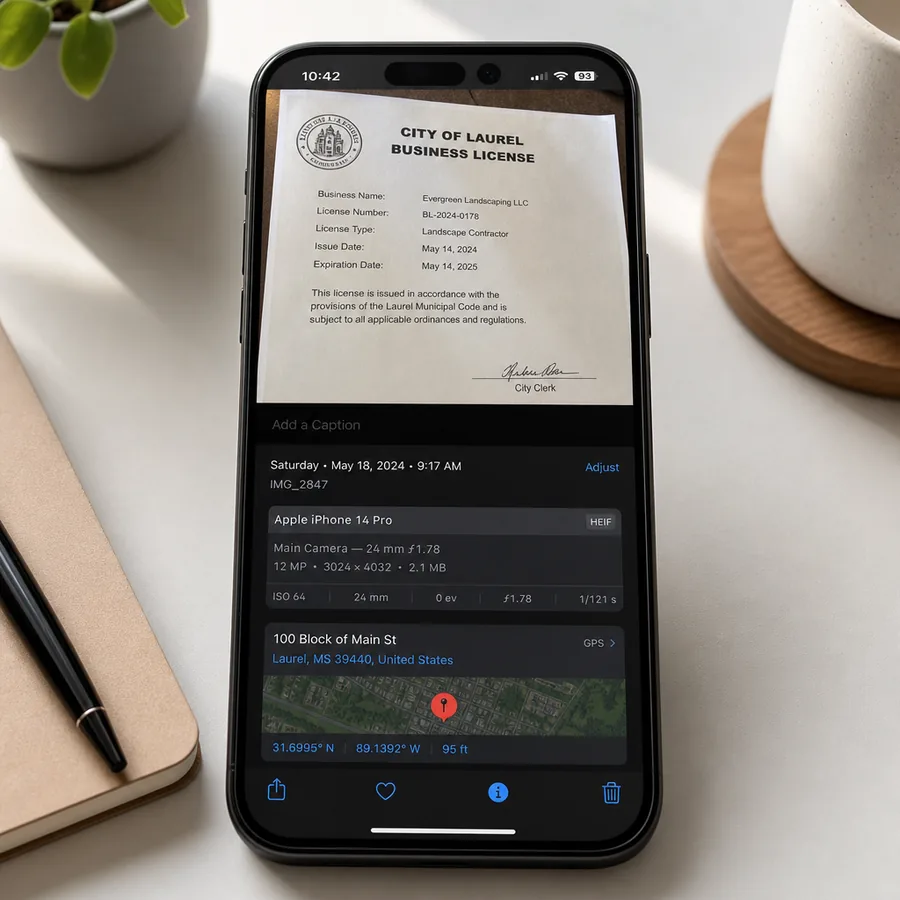
Imagine this scenario:
You photograph every page of your onboarding packet the day you receive it. You use your smartphone's native camera app with location services enabled. The photo metadata records the date, time, and GPS coordinates.
Six months later, the employer produces a packet that includes a mandatory arbitration clause on page 7.
Your day-one photo shows page 7 was a benefits-election form—no arbitration language anywhere.
Now, here's where it gets interesting:
The employer must explain the discrepancy. Did HR insert the arbitration page later? Did someone substitute pages in your personnel file? Did the company adopt arbitration mid-year and backdate signatures?
Any explanation undermines the document's authenticity. And once authenticity is challenged, the burden shifts to the employer to prove the document is what it claims to be under Federal Rule of Evidence 901.
Your contemporaneous photo becomes powerful evidence because it was created before any dispute arose—exactly the quality courts prize in business records.
What Courts Look for in Authentic Onboarding Records
Judges evaluating document authenticity examine several factors:
Temporal proximity. Was the record created at or near the event it documents? A photo timestamped to your hire date carries presumptive weight.
Routine business practice. Does the employer have a consistent system for assembling onboarding packets? If every new hire gets a numbered checklist and your photo shows checklist #4472, but the employer produces #4472-A with additional pages, the inconsistency demands explanation.
Custodial chain. Who maintained the file from creation to production? If the HR generalist who onboarded you left the company and the litigation coordinator assembled the production from "archived materials," that gap invites scrutiny.
Metadata consistency. PDF creation dates, modification dates, and author fields often contradict employer claims. When your day-one photo shows a clean original and the employer's production shows a PDF created two days after you filed your EEOC charge, that's a red flag.
But it gets better:
Employers often don't realize when personnel-file production becomes evidence against the employer. Metadata forensics can reveal document assembly timelines that directly contradict sworn declarations.
Why Waiting Until a Dispute Arises Is Too Late
You cannot recreate the evidentiary value of a day-one photo after a legal claim surfaces.
Once you've filed an EEOC charge or complained internally about retaliation, any documentation you create is potentially impeachable as self-serving.
Courts understand humans have strong incentives to reconstruct events in their favor once litigation begins. That's why Palmer v. Hoffman excludes litigation-driven records even when they're routine business practice.
The same skepticism applies to employee-created records assembled after a dispute.
Here's the thing:
A photo taken on day one—before any protected activity, before any adverse action, before any reason to anticipate litigation—is inherently credible because you had no motive to fabricate.
You were simply preserving what you received, the way you might photograph a lease agreement or a car-purchase contract.
That temporal innocence is irreplaceable once the relationship sours.
What to Photograph and How to Preserve It
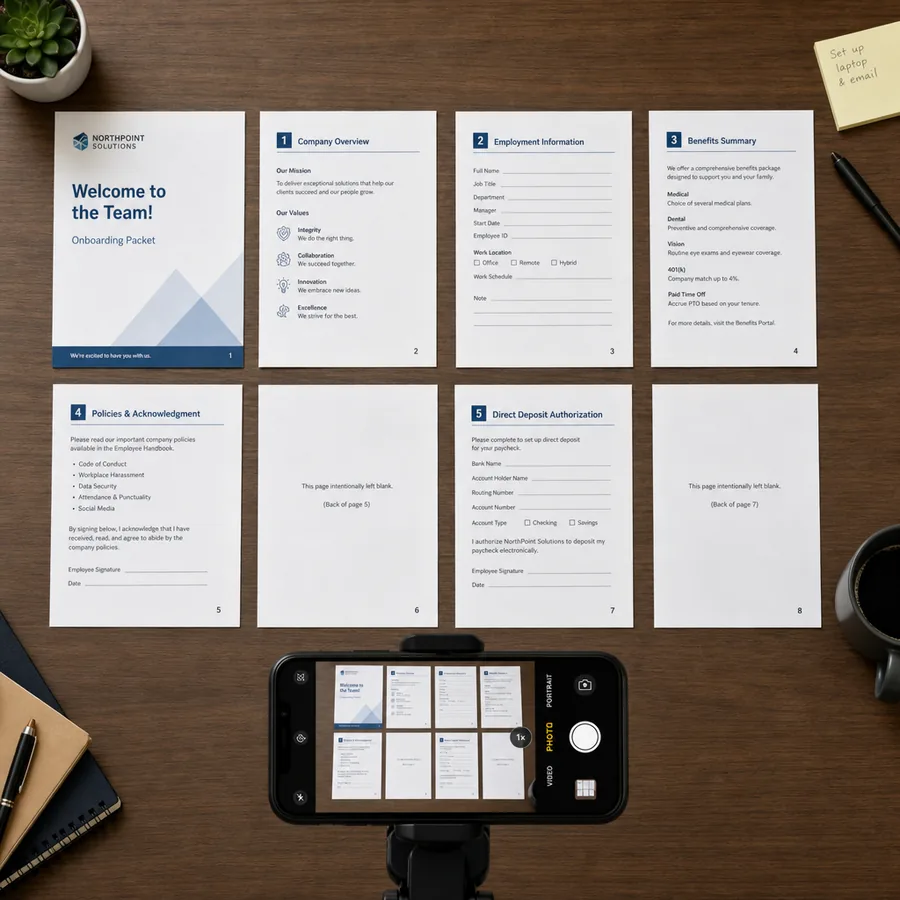
Effective contemporaneous documentation requires methodical practice.
Photograph every page. Don't just snap the signature page. Photograph every document in the onboarding packet, in order, with visible page numbers if present.
Include any cover sheet or checklist. If HR gives you a transmittal memo listing the enclosed forms, photograph it first. It establishes what should be in the packet according to the employer's own records.
Capture both sides if double-sided. Employers sometimes claim additional terms appeared on the reverse of a form you photographed only from the front.
Preserve the original file. Upload the photos to cloud storage the same day. Do not edit, crop, or convert them. Courts can verify timestamps and EXIF data from original camera files but not from edited copies.
Email yourself a copy with date-stamped subject line. Sending the photos to your personal email creates a third-party timestamp (the mail server's received-date header) that's difficult for anyone to alter retroactively.
Now, here's where it gets interesting:
You can apply the same technique to documenting workplace retaliation as events unfold. Contemporaneous notes, screenshots, and photos made in the regular course of your work—not assembled for litigation—carry the same evidentiary advantages.
How Employers Challenge Late-Appearing Documents
Sophisticated employment attorneys use several strategies when employers produce suspicious onboarding materials.
Depose the custodian of records. Ask who assembled the production, from what sources, and when. If the HR coordinator admits she "pulled everything from the file" three weeks after the EEOC charge, that undermines regular-course claims.
Request metadata for all PDFs. PDF properties reveal creation dates, modification dates, and software used. A document allegedly signed in 2022 but converted to PDF in 2024 requires explanation.
Compare against other employees' packets. If ten employees hired the same month received identical checklists but your packet alone includes an arbitration clause, that pattern suggests selective insertion.
Subpoena the document-management system logs. Enterprise HR systems track every access, edit, and print event. Logs showing your personnel file was accessed the day before production—and not accessed in the two years prior—tell a story.
But it gets better:
When your day-one photos directly contradict the employer's production, you shift the burden entirely onto the employer to explain the inconsistency. No explanation survives scrutiny when your timestamped photo shows a different document.
Real-World Scenarios Where Day-One Photos Matter
Arbitration-agreement disputes. Employers frequently claim employees signed mandatory arbitration agreements at hire. A photo showing no such agreement in your onboarding packet defeats that claim outright.
Handbook-acknowledgment backdating. Companies update handbooks mid-year and sometimes insert new acknowledgment forms into personnel files with signatures "transferred" from earlier versions. Your photo of the actual handbook you received on day one proves what policies were in effect when you started.
Non-compete scope expansion. Some employers produce non-compete agreements during litigation with geographic or durational restrictions broader than what you recall signing. Your photo establishes the original scope.
Job-description modifications. When retaliation claims involve allegations that the employer changed your duties, a photographed job description from your onboarding packet shows what role you were hired to perform.
Compensation-agreement alterations. Employers defending wage claims sometimes produce offer letters or commission schedules with terms different from what you received. Your day-one photo preserves the original agreement.
Why Metadata Alone Isn't Enough Without Contemporaneous Originals
You might think, "The employer's own metadata will expose fake documents."
Sometimes. But not always.
Employers can print a document, have you sign it, scan the signed version, and create a PDF. The PDF creation date reflects the scan date, not the original document's creation.
Without your own contemporaneous record, you're arguing about what might have been in the original versus what the employer claims was in it.
Your day-one photo eliminates the ambiguity.
It's not "I don't remember signing that clause." It's "Here is a photograph of the packet I received, timestamped to my hire date, showing no such clause existed."
That's the difference between a credibility contest and documentary proof.
How This Doctrine Interacts With Spoliation Claims
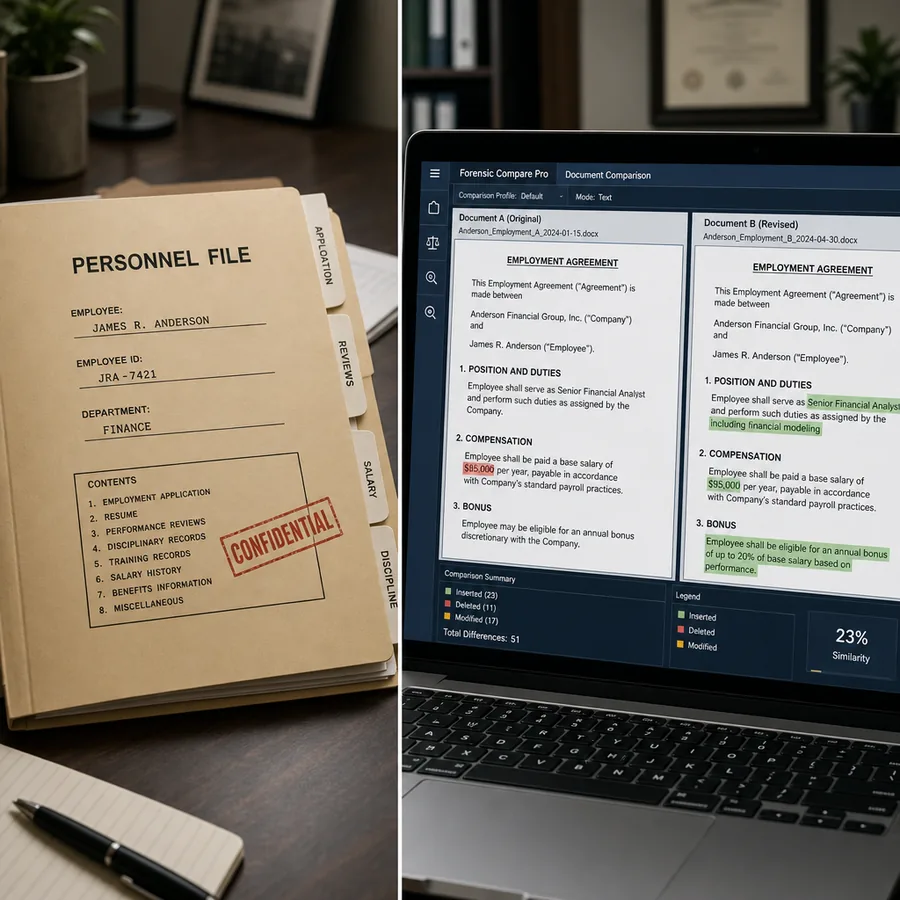
When an employer produces a document that contradicts your day-one photo, you've also potentially established spoliation—destruction or alteration of evidence.
Spoliation gives rise to adverse-inference jury instructions in many circuits. The court tells the jury, "You may infer that the missing or altered document would have been unfavorable to the employer."
Your contemporaneous photo proves three elements:
- The original document existed (you photographed it)
- The employer had control over it (it was in your personnel file)
- The employer altered or replaced it (the produced version differs from your photo)
That's a complete spoliation claim, triggered by a simple smartphone photo.
Practical Limits: What Photos Can't Prove
Contemporaneous documentation has limits.
A photo proves what you received. It doesn't prove you read it, understood it, or relied on it. Employers can still argue you had constructive notice of policies posted on an intranet or distributed later.
A photo proves what existed on day one. It doesn't prevent the employer from lawfully amending policies prospectively with proper notice.
A photo proves the packet's contents. It doesn't prove the employer acted with retaliatory intent or that any specific adverse action was unlawful.
Here's the thing:
Contemporaneous photos are defensive evidence. They block the employer from rewriting history. They don't, by themselves, prove your retaliation claim.
But blocking false narratives is half the battle in employment litigation.
Frequently Asked Questions
Can my employer prohibit me from photographing onboarding documents?
Employers can adopt policies restricting photography of confidential or proprietary materials. However, standard onboarding forms—tax documents, direct-deposit authorizations, policy acknowledgments—are your personal records, not trade secrets. Many employees photograph these documents the same way they'd photograph a signed lease. Whether any specific policy applies to your situation depends on the exact language and your jurisdiction's laws.
What if I only photographed some pages of my onboarding packet?
Partial documentation still has evidentiary value. If you photographed pages 1-5 and the employer produces a six-page packet with different content on page 3, your photo of the original page 3 creates the same authenticity problem. Courts evaluate evidence cumulatively—even one contradictory photo raises questions about the entire production.
Do screenshots of emailed onboarding documents work the same way as photos?
Email screenshots are less robust than camera-roll photos because they lack embedded metadata like GPS coordinates and often show only partial headers. However, the email itself—if you preserve it in your inbox—carries strong authentication through mail-server headers. Forward onboarding emails to a personal account and never delete the originals. The headers prove when the email was sent and what attachments it contained.
How long should I keep day-one photos of onboarding documents?
Employment claims have statutes of limitation ranging from 180 days (some EEOC charges) to several years (contract claims). As a practical matter, preserve onboarding documentation for at least as long as you remain employed, plus the longest statute of limitation in your jurisdiction. Cloud storage makes indefinite preservation simple and costless.
Can the employer argue my photos are fake or edited?
Any evidence can be challenged. However, smartphone photos contain EXIF metadata—timestamp, device identifier, GPS coordinates—that is difficult to falsify convincingly. Forensic analysis can detect manipulation. The employer bears the burden of proving your photos are inauthentic, which requires expert testimony and often fails when the metadata is intact. Preserve original files, never edit them, and the authenticity challenge rarely succeeds.