When Personnel-File Production Becomes Evidence Against the Employer

You just received a discovery production labeled "Complete Personnel File – Jane Smith."
The PDF is 147 pages. It arrived on disk two days before the discovery deadline. And when you check the metadata, every single page was scanned on the same afternoon—three months after the EEOC charge was filed.
Here's what you're about to learn: PDF metadata can transform an employer's own production into smoking-gun evidence that the file was assembled for litigation, not maintained in the regular course of business.
That distinction collapses the Federal Rules of Evidence 803(6) business-records exception—and can turn a defense exhibit into a liability.
In this guide, you'll discover:
- Why the timestamp on a scanned document matters as much as what's written on the page
- How Palmer v. Hoffman governs what counts as a "business record" versus litigation prep
- What happens when a personnel file fails the FRE 803(6) foundation test
The Business-Records Exception Requires Business-Record Timing
Under Federal Rule of Evidence 803(6), a record made "at or near the time" of the event it describes can be admitted without the author appearing in court to testify.
That's the business-records hearsay exception.
But there's a catch: the record must be "made in the course of a regularly conducted activity of a business."
In Palmer v. Hoffman, 318 U.S. 109 (1943), the U.S. Supreme Court held that an accident report prepared by a railroad employee after a fatal crossing collision was not admissible under the business-records exception—even though the railroad routinely prepared such reports after every accident.
Why? Because the primary purpose of the report was to prepare for anticipated litigation, not to document operations in real time.
The Court wrote that the phrase "regular course of business" contemplates regularity of conduct, not just regularity of subject matter.
Here's the thing:
That same principle applies when an employer assembles a "personnel file" in response to a charge or complaint.
How PDF Metadata Reveals Litigation Assembly
Modern document production is digital.
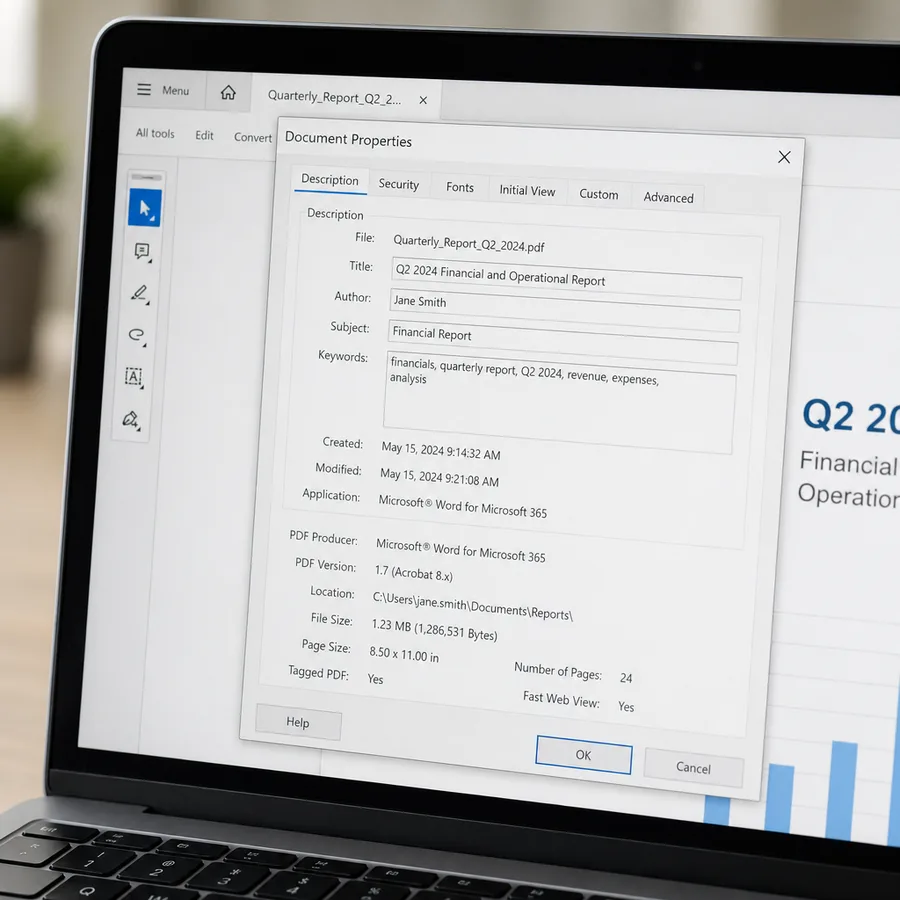
And digital files contain metadata: embedded timestamps that record when the file was created, modified, scanned, or converted to PDF.
When you receive a multi-hundred-page personnel file as a single PDF, check the metadata. Most PDF readers (Adobe, Preview, Foxit) let you view "Document Properties" or "File Info."
Look for these fields:
- Created: when the PDF was first generated
- Modified: when it was last edited
- Application: the software used (e.g., "Xerox WorkCentre" indicates batch scanning)
- Producer: the tool that assembled the final document
If all 147 pages show a "Created" timestamp of 4:23 PM on October 12, 2024—and the EEOC charge was filed August 1, 2024—you're looking at a file assembled after the charge, not maintained during employment.
Now, here's where it gets interesting:
That metadata becomes evidence that the "personnel file" was compiled for litigation, not kept in the regular course of business.
What Happens When the FRE 803(6) Foundation Collapses
If the personnel file can't satisfy the business-records exception, two things happen.
First: The employer loses the ability to use the file affirmatively at trial.
Without FRE 803(6), each page of the file is hearsay—an out-of-court statement offered to prove the truth of the matter asserted. The employer would need to call the author of each document to authenticate it and testify to its contents.
That's impractical for a 147-page compilation assembled from emails, notes, reviews, and memos written by a dozen different people over three years.
Second: The employee can still use the file's existence and contents against the employer.
Why? Because Federal Rule of Evidence 801(d)(2) treats statements made by a party's agent as non-hearsay when offered against that party.
The file becomes a party-opponent admission.
So the employer can't use the file to support its defense, but the employee can use it to support her claim.
Here's the asymmetry in practice:
The employer wants to introduce a performance-improvement plan dated six months before the protected activity. Without FRE 803(6), the employer must call the supervisor who wrote it—and that supervisor will be cross-examined about why the PIP wasn't formally delivered, why no follow-up occurred, and why it was never mentioned in the termination letter.
Meanwhile, the employee can introduce the same PIP to argue that it was created post-hoc to manufacture a paper trail—because the metadata shows it was scanned the day before discovery closed.
When Timing Alone Triggers Spoliation Concerns
Metadata that shows last-minute assembly can do more than defeat the business-records exception.
It can also raise an inference of spoliation.
If the file was scanned in bulk on October 12, what happened to the original documents? Were they destroyed? Were pages omitted? Was the selection curated?
Courts in employment cases have held that the duty to preserve arises when litigation is "reasonably foreseeable"—typically no later than the filing of an EEOC charge. (For more on preservation timing, see Zubulake and the Duty to Preserve in Employment Cases.)
When an employer waits three months after a charge to scan a "complete" file, the question becomes: what existed before the scan?
But it gets better:
If the employer claims the file was "complete" and "contemporaneous," but metadata contradicts that claim, the contradiction itself is evidence of bad faith.
How Courts Distinguish Regular-Course Records from Litigation Files
Not every post-charge document is litigation prep.
Courts apply Palmer v. Hoffman by asking: What was the primary purpose of creating the record?
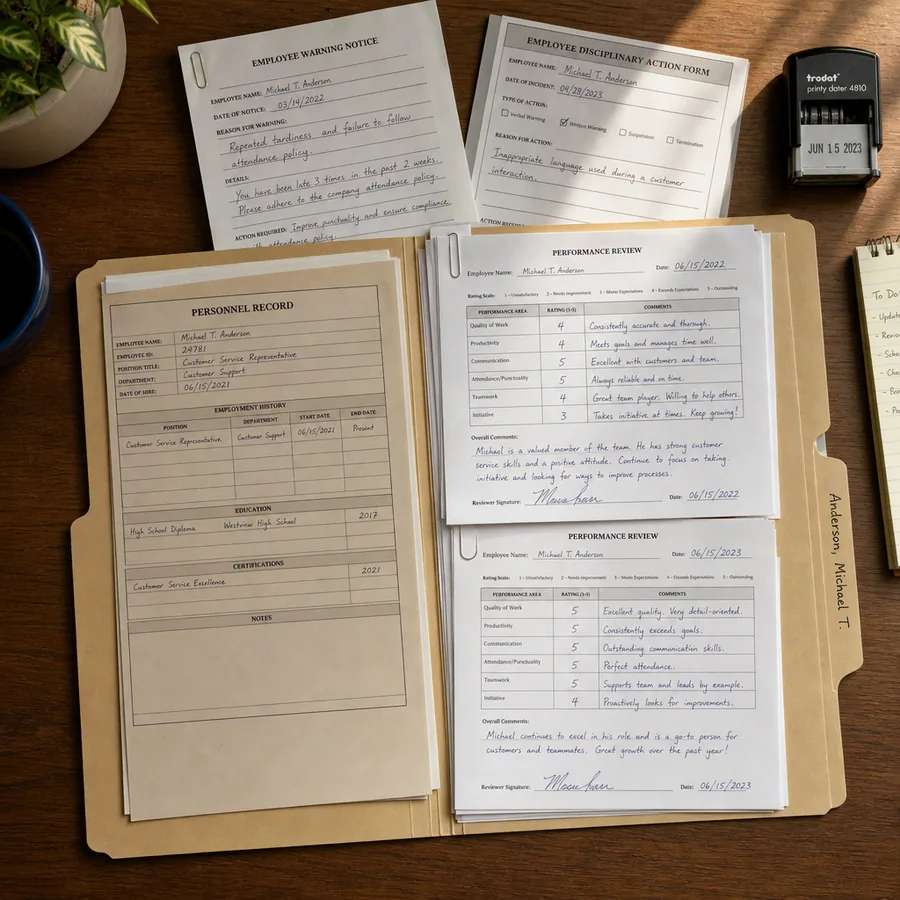
A performance review completed on the employee's anniversary date—before any complaint—is likely admissible under FRE 803(6), even if it's later scanned and produced in litigation.
A "summary of performance issues" typed by HR the day after the employee's attorney sent a demand letter is not.
The key is timing and motive:
- Was the document created as part of the employer's ordinary record-keeping practice?
- Or was it created because legal trouble arrived?
Metadata can answer both questions.
If the employer's policy manual says performance reviews are conducted annually in January, but the metadata shows this employee's review was created in July—two weeks after she filed a charge—the timing speaks for itself.
For a deeper dive into how courts evaluate whether a record was made "in the regular course of business," see Palmer v. Hoffman and the Business-Records Exception.
What This Means for Document Production Strategy
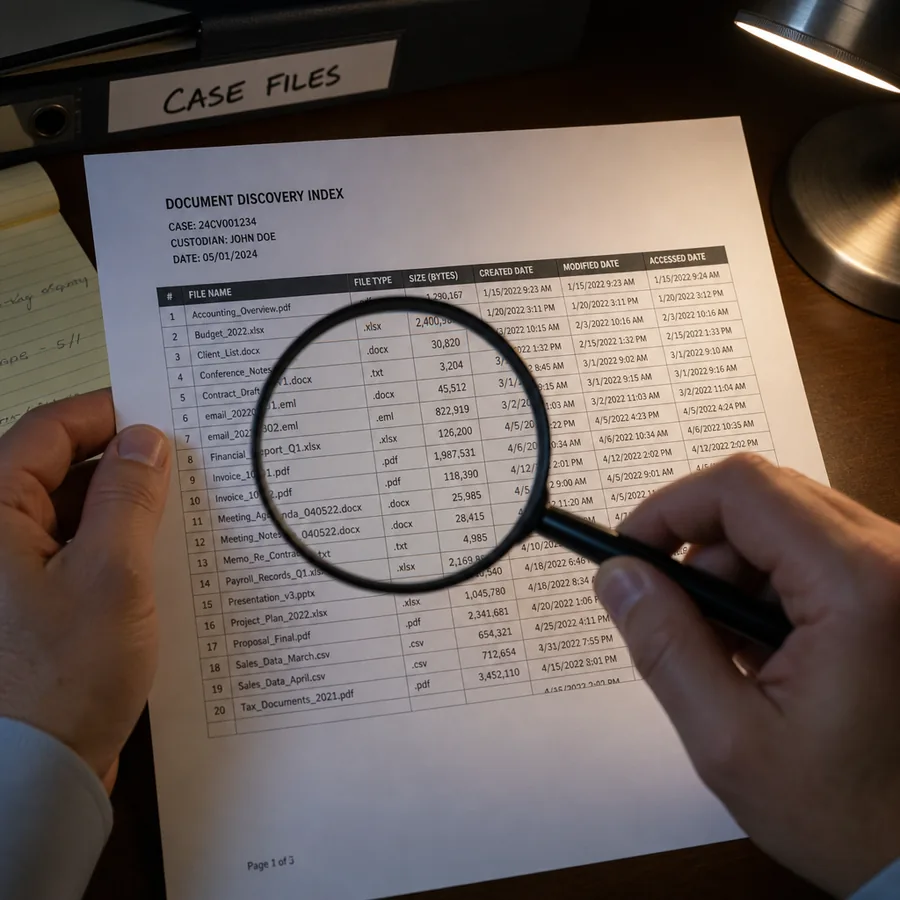
If you're reviewing an employer's personnel-file production, treat metadata as a source document in its own right.
Pull the properties. Compare timestamps. Look for patterns:
- Were all pages scanned on the same day?
- Does that day fall after the charge, complaint, or demand letter?
- Do the file names or directory paths contain the word "litigation," the employee's name plus "EEOC," or similar flags?
If the answer to any of these is "yes," the metadata may disqualify the file as a business record under FRE 803(6)—and transform it into evidence that the employer assembled a litigation file, not a personnel file.
That distinction matters at trial.
It matters at summary judgment.
And it matters in settlement, because metadata-driven impeachment of a "complete" file can shift the credibility calculus in the employee's favor.
Frequently Asked Questions
Can an employer "fix" bad metadata by re-scanning the file?
Re-scanning doesn't cure the foundational problem under Palmer v. Hoffman. If the original documents were assembled for litigation, creating a new scan with a later timestamp only adds another layer of post-hoc compilation. Courts evaluate the purpose of the record's creation, not the format of its production.
Does FRE 803(6) apply differently in administrative proceedings versus federal court?
The Federal Rules of Evidence govern in federal court. Many administrative tribunals (like EEOC hearings or state labor boards) use more relaxed evidentiary standards and may admit business records without strict foundational proof. But the Palmer principle—that litigation-driven documents aren't "regular course" records—has persuasive force even outside formal FRE 803(6) contexts.
What if only some pages of the personnel file have suspicious metadata?
Mixed metadata can still be powerful. If 120 of 147 pages were scanned years ago but 27 pages were created last week, those 27 pages are likely litigation prep—and their inclusion in the "personnel file" undermines the employer's claim that the file is a complete, contemporaneous business record. The employee can use the metadata discrepancy to argue selective curation.
Can an employer object to the employee's use of metadata at trial?
Metadata is part of the document itself under Federal Rule of Evidence 1001(a) (defining "writing" to include stored data). Authenticating metadata typically requires only testimony that the file is what it purports to be—often satisfied by the employer's own discovery responses or the testimony of whoever produced the file. Objecting to metadata is like objecting to the letterhead on a printed memo.
What happens if the employer claims the originals were lost and only the scanned copies exist?
That claim can trigger a spoliation analysis separate from the Palmer issue. If originals were destroyed after the duty to preserve arose, the employer may face sanctions—and the metadata showing when the scans were created becomes evidence of when the originals disappeared. The later the scan date, the stronger the inference that intervening documents were lost or destroyed.