Can You Use Text Messages as Evidence in Court? Yes — If Your Supervisor Sent Them
Two conditions people miss. You still have to authenticate it — show it is really from who you say (FRE 901), which a screenshot plus the number and context normally does. And the rule runs one direction only: your own texts, offered by you, stay hearsay. The text-message rules in detail ↓

You've just received a carefully worded email from your employer's HR director.
She assures you that "we have produced all responsive documents" or "there are no other emails on this topic."
You suspect that's not true—but can you actually use that statement against the company in court?
Yes. And it's more powerful than you might think. The same rule covers the text your manager sent at 11pm, the Slack message from HR, and the email you were copied on.
In this article, you'll learn how Federal Rule of Evidence 801(d)(2)(D) transforms statements by HR personnel, supervisors, and in-house counsel into binding admissions against your employer. You'll see:
- The Mahlandt rule and why agent statements aren't hearsay
- How the "scope of employment" test works (and why it's broader than you expect)
- The four-way evidentiary trap HR directors create when they close the records universe
What FRE 801(d)(2)(D) Actually Says
Federal Rule of Evidence 801(d)(2)(D) treats certain statements as "not hearsay."
Specifically: a statement offered against an opposing party that was made by the party's agent or employee, on a matter within the scope of that relationship and while it existed.
Translation: When your employer's HR director, general counsel, or line supervisor makes a statement about something related to their job, that statement is admissible against the employer as substantive evidence.
Not as hearsay. As fact.
The Mahlandt Rule: No Personal Knowledge Required
The landmark case is Mahlandt v. Wild Canid Survival & Research Ctr., 588 F.2d 626 (8th Cir. 1978).
A boy was bitten by a wolf at a research center. The plaintiff sought to introduce a report written by the center's secretary, describing the incident.
The trial court excluded it as hearsay.
The Eighth Circuit reversed. The court held that statements by agents or employees concerning matters within the scope of their employment are admissible against the principal as party-opponent admissions—without requiring proof that the agent had personal knowledge or authority to make binding statements.
Here's the thing:
The Mahlandt rule eliminated two traditional barriers to admissibility. The agent doesn't need firsthand knowledge of the facts. And the agent doesn't need formal authority to speak for the company.
If the statement relates to the agent's job duties, it comes in.
Text Messages Specifically: Three Rules, in Order
Nothing in Rule 801(d)(2)(D) cares what medium the statement arrived in. A text message from your manager is treated exactly like a memo from your manager. But a text has to clear two more rules that a signed letter usually clears on its face, and the order matters.
1. Is it hearsay? No — if the sender worked for the employer and the message is about your job. That is Rule 801(d)(2)(D), covered above. "Corporate wants you gone before your leave ends" from a supervisor is an admission by the company. The same message forwarded by a co-worker with no supervisory role is not, because it falls outside that person's scope of employment.
2. Can you prove it is real? This is authentication, FRE 901(a), and it is the step people skip. You need evidence sufficient to support a finding that the message is what you say it is. In practice Rule 901(b)(4) does the work: distinctive characteristics taken with the circumstances — the number it came from, the sender's name in your contacts, details only that person would know, a reply that answers what you actually asked.
3. Is a screenshot good enough? Usually. FRE 1003 makes a duplicate admissible to the same extent as the original unless there is a genuine question about the original's authenticity, or admitting the copy would be unfair. A screenshot that crops out the date, the sender or the surrounding messages invites exactly that objection, which is why full-thread captures beat clipped ones.
The "Scope of Employment" Test
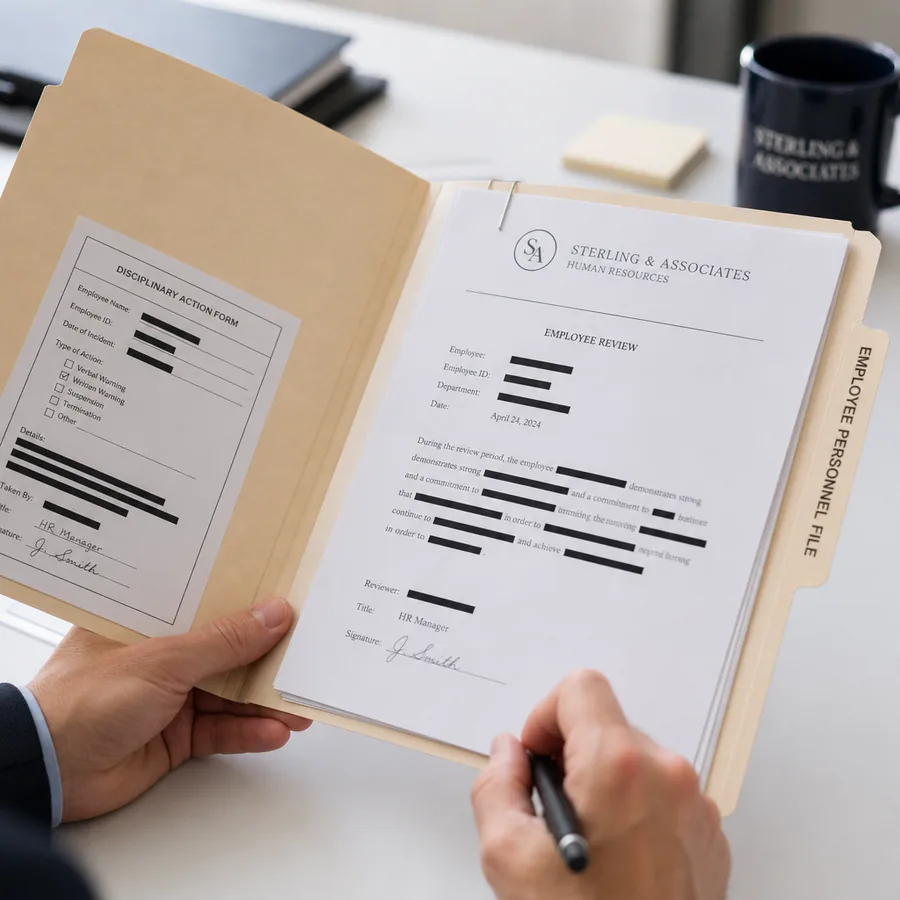
So what counts as "within the scope of employment"?
Courts apply a functional test. Did the statement concern a topic the agent was hired to handle, investigate, or manage?
For an HR director, that includes:
- Statements about the existence or completeness of personnel files
- Representations about what performance reviews exist
- Claims that "all emails responsive to your request have been produced"
- Descriptions of the company's document-retention policies
For a line supervisor, scope includes:
- Statements about an employee's job duties or performance
- Explanations for scheduling or assignment decisions
- Communications about workplace incidents the supervisor witnessed or investigated
For in-house counsel, scope includes:
- Representations about what documents exist in litigation holds
- Statements about corporate policies or their application
- Descriptions of investigations the legal department conducted or oversaw
Now, here's where it gets interesting:
The scope-of-employment test is satisfied even if the agent's statement was wrong, incomplete, or made negligently.
If an HR director says "we have no other disciplinary records for this employee," and that turns out to be false, the statement is still admissible. In fact, its falsity makes it more valuable as evidence.
The Records-Universe Closure Trap

This brings us to the strategic significance of FRE 801(d)(2)(D) in retaliation cases.
When an HR director or in-house counsel makes a statement that purports to close the universe of responsive records—"there are no additional documents," "this is everything," "we've produced all emails on this subject"—that statement locks the employer into one of four positions.
Each position creates evidentiary problems:
Position 1: The records never existed. If disciplinary files, performance reviews, or incident reports were never created, the employer may have violated record-keeping regulations (OSHA, FLSA, Title VII compliance requirements). The absence itself becomes evidence of negligence or indifference.
Position 2: The records existed but were destroyed. Now you have a spoliation issue. Why were they destroyed? When? Under what policy? Was the destruction routine or targeted? The employer must explain—and any gaps in the explanation support an adverse-inference instruction.
Position 3: The records exist but were withheld. This is a discovery violation. The employer certified completeness (via the HR director's statement). Withholding documents after that certification exposes the company to sanctions, including entry of judgment on contested facts.
Position 4: The produced set is complete. If the employer stands by the HR director's representation, then the absence of certain categories of documents becomes substantive evidence. No written warnings before termination? The "performance" justification weakens. No contemporaneous complaint about the protected activity? The "we didn't know" defense fails.
The employer can't escape this trap by claiming the HR director "misspoke" or "didn't have complete information."
Under FRE 801(d)(2)(D), her statement is admissible precisely because she was the agent responsible for maintaining or producing those records. If she didn't know, that's an indictment of the company's record-keeping—not a reason to exclude her statement.
Practical Significance: How Courts Actually Use Agent Admissions
Courts use FRE 801(d)(2)(D) admissions in three main ways.
First: To establish factual predicates without live testimony. A statement by an HR director in an email or letter can prove that certain records don't exist, that a policy was or wasn't followed, or that an investigation reached a particular conclusion—without calling the HR director as a witness.
Second: To impeach inconsistent defenses. If the HR director said in discovery responses that "no performance issues were documented prior to the complaint," the employer can't later claim at trial that poor performance was the real reason for termination. The earlier admission forecloses the later argument.
Third: To support adverse inferences. When the HR director's statement closes the records universe, courts are more willing to infer that missing categories of evidence would have been unfavorable to the employer. The admission shifts the burden: the employer must explain the absence, not the plaintiff.
But it gets better:
Because FRE 801(d)(2)(D) admissions are substantive evidence (not hearsay), they can defeat summary judgment on their own. A single email from an HR director admitting that "we have no documentation of the performance issues cited in the termination letter" can create a genuine dispute of material fact on pretext.
What "Agent" Means (And Doesn't Mean)
FRE 801(d)(2)(D) applies to "agents" and "employees."
Courts interpret both terms broadly. The person making the statement doesn't need a fancy title.
Statements by the following are typically admissible as party-opponent admissions:
- HR directors, HR managers, and HR business partners
- General counsel and in-house attorneys
- Direct supervisors and managers with oversight responsibility
- Investigators assigned to look into complaints
- Senior executives speaking about matters within their divisions
The key is the scope-of-employment nexus, not the formality of the agent's role.
Statements by the following are less likely to qualify (absent special circumstances):
- Co-workers with no supervisory or investigative role
- Outside consultants or contractors (unless acting as the company's agent)
- Former employees speaking after their employment ended
One wrinkle: Statements by in-house counsel are admissible unless protected by attorney-client privilege. If the lawyer is speaking in her capacity as corporate counsel about a legal strategy or confidential communication, privilege may apply. But if she's speaking as the company's records custodian or investigator, the statement typically comes in under FRE 801(d)(2)(D).
Why This Matters in Retaliation Cases
Retaliation cases often turn on the employer's explanation for the adverse action.
Was the plaintiff terminated for performance? For restructuring? For policy violations?
The employer's story is usually told through documents—and through statements by the people who control those documents.
FRE 801(d)(2)(D) ensures that those statements can't be walked back.
If the HR director said in a response to an EEOC charge that "no performance issues were documented," the company can't later claim at trial that a pattern of poor performance justified the firing. The admission is already in evidence.
If the general counsel certified in discovery that "all responsive emails have been produced," the company can't argue at trial that additional emails (conveniently discovered later) undermine the plaintiff's timeline. The certification closed the universe; late-arriving documents either prove withholding or weren't actually responsive.
This is why The Records-Universe Closure Trap is so powerful: it converts the employer's own agents into witnesses for the plaintiff, without the need for live testimony or cross-examination.
The Four-Way Problem in Detail

Let's walk through a concrete example.
Suppose you file a retaliation lawsuit. In discovery, you request "all performance reviews, disciplinary write-ups, and manager notes concerning Plaintiff from January 2020 to present."
The HR director responds: "We have produced all responsive documents. There are no additional materials."
But you notice the production contains no manager notes at all. No emails from your supervisor commenting on your work. No contemporaneous documentation of the "performance problems" the company now cites as the reason for your termination.
Here's what the HR director's admission means:
If the notes never existed: Your manager didn't document any performance concerns in real time. That undermines the employer's claim that performance was the true reason for termination. Courts view contemporaneous documentation as more credible than post-hoc explanations. The absence—confirmed by the HR director's admission—supports a finding of pretext.
If the notes were destroyed: When? Under what policy? Was the destruction consistent with the company's ordinary document-retention schedule, or was it targeted? The employer must produce evidence (policy manuals, metadata, witness testimony) explaining the destruction. Any gaps support an adverse inference: the destroyed notes would have contradicted the "performance" narrative.
If the notes exist but were withheld: The HR director's statement ("we have produced all responsive documents") was false. That's a discovery violation. You can move for sanctions. The court may strike the employer's performance defense, enter judgment on contested facts, or instruct the jury to presume the withheld notes were favorable to you.
If the produced set truly is complete: Then the absence of manager notes is a fact the jury will consider. Why didn't the manager document concerns if performance was really the issue? The employer may argue the manager was lax or informal—but that explanation competes with the "we terminated for well-documented performance issues" narrative. The internal contradiction weakens credibility.
Notice: In all four scenarios, the HR director's admission creates an evidentiary problem for the employer.
The admission doesn't guarantee you win. But it forecloses the employer's easiest escape route: claiming uncertainty about what records exist or blaming incomplete production on miscommunication.
Common Employer Arguments (And Why They Fail)
Employers facing damaging agent admissions raise predictable objections.
"The HR director didn't have personal knowledge." Irrelevant. Mahlandt eliminated the personal-knowledge requirement for party-opponent admissions. If the statement concerned a matter within the scope of the agent's employment, it's admissible—even if the agent relied on secondhand information or made a mistake.
"The statement wasn't authorized by senior management." Also irrelevant. FRE 801(d)(2)(D) doesn't require that the agent have authority to make binding legal commitments. Scope of employment is the test, not level of authority.
"The HR director misspoke or didn't understand the request." That goes to weight, not admissibility. The statement is still admissible. The employer can argue the jury shouldn't credit it—but the jury gets to hear it and decide.
"Admitting this statement would be unfair." Fairness cuts the other way. The employer chose to assign this person responsibility for records, investigations, or HR functions. The employer is bound by statements its agents make in the course of that work. That's basic agency law, codified in the Federal Rules of Evidence.
Frequently Asked Questions
Does FRE 801(d)(2)(D) apply in state court employment cases?
Most state evidence codes have parallel provisions modeled on the Federal Rules. The doctrine is widely recognized, though the specific rule number may vary by jurisdiction. An attorney licensed in your state can confirm whether your state's rules include a party-opponent admission exception for agent statements.
Can an HR director's statement in an internal email be used under FRE 801(d)(2)(D)?
Yes, if the email concerns a matter within the scope of the HR director's employment and you can authenticate it (prove it's genuine). Internal emails are frequently admitted as party-opponent admissions because they reflect what the agent said in the course of business, often with less filtering than formal responses.
What if the HR director says "I don't recall" or "I'd have to check" instead of making a definitive statement?
Evasive or non-responsive answers are less useful as admissions, but they may still have evidentiary value. If the HR director is the designated records custodian and can't answer basic questions about what records exist, that undermines the employer's credibility on records production. Courts sometimes draw adverse inferences from a custodian's inability to provide straightforward answers.
Does the agent need to still be employed at the time of trial for the statement to be admissible?
No. FRE 801(d)(2)(D) requires only that the statement was made while the agency relationship existed and concerned a matter within its scope. If the HR director made the statement while employed, it's admissible even if she left the company before trial.
Can I use a supervisor's statement against my employer if the supervisor was later fired?
Generally yes, as long as the statement was made during the supervisor's employment and within the scope of her duties. The employer can't insulate itself from admissions by terminating the agent who made them. The statement remains attributable to the company as a party opponent.