Fired After Your Work Content Went Viral? Here's How Their Own Words Become Evidence Against Them

You posted something work-related that went viral. Three days later, you were fired.
Your employer claims it was performance. Or policy violation. Or "cultural fit."
But here's what most terminated employees don't realize: everything your employer's HR director, legal counsel, or authorized manager says about why you were fired becomes binding evidence against them in court — even if those statements contradict each other, even if the person making them had no firsthand knowledge of your situation, and even if the company later changes its story.
This article shows you exactly how federal evidence rules turn your employer's own statements into admissions they can't take back.
Why Your Employer's Official Statements Become Binding Admissions
When you're terminated after viral content, your employer will give reasons. Those reasons come from specific people: the HR director who signs your termination letter, the general counsel who drafts the separation agreement, the operations manager who explains the decision to remaining staff.
Under Federal Rule of Evidence 801(d)(2)(D), statements made by the company's agents or employees concerning matters within the scope of their employment are not hearsay. They're admissible as substantive evidence of the truth of what was said.
The landmark case is Mahlandt v. Wild Canid Survival & Research Ctr., 588 F.2d 626 (8th Cir. 1978). The court held that when an employee makes a statement about a matter within their job duties, that statement is automatically admissible against the employer — no need to prove the employee had personal knowledge or authority to legally bind the company.
This rule applies to:
- Termination letters
- Exit interview notes
- Internal emails explaining the decision
- Statements to unemployment agencies
- Discovery responses in litigation
- Declarations by company counsel
The Records-Universe Closure Trap

Here's where the admission doctrine becomes particularly powerful in viral-content termination cases.
Your attorney requests all documents related to the social media policy you allegedly violated. The company's general counsel responds: "We have produced all responsive documents. No additional records exist."
That statement closes the records universe. It's an admission under FRE 801(d)(2)(D) because it concerns a matter within the scope of counsel's employment (responding to discovery).
Now the employer faces a four-option trap:
Option 1: The records never existed (suggesting no actual policy was in place when you were terminated).
Option 2: The records existed but were destroyed (potential spoliation of evidence).
Option 3: The records exist but were withheld (discovery violation subject to sanctions).
Option 4: The produced set is complete (which may substantiate your claim that the stated reason was pretextual).
Each option creates evidentiary problems for the employer. The admission that the universe is closed eliminates the escape hatch of "we'll look for more documents later."
Here's the thing:
The company can't un-ring that bell. Once their authorized agent makes the statement, it's in the record as the company's position.
How Shifting Explanations Prove Pretext Under McDonnell Douglas
Viral-content terminations often produce multiple, evolving explanations. The initial termination letter says one thing. The unemployment response says another. The litigation position says a third.
Each statement is an admission. When they contradict each other, they create a pretext showing.
The Supreme Court established the pretext framework in McDonnell Douglas Corp. v. Green, 411 U.S. 792 (1973). The employer must articulate a legitimate, non-discriminatory reason for the termination. The employee can then demonstrate that the stated reason is pretext for the actual (unlawful) motive.
In St. Mary's Honor Ctr. v. Hicks, 509 U.S. 502 (1993), the Court clarified that showing pretext doesn't automatically win the case, but it permits — and often compels — an inference of discriminatory intent.
Here's how the admission doctrine supercharges pretext arguments:
Day 1: Termination letter states "violation of social media policy prohibiting disclosure of internal operations."
Day 45: Unemployment agency receives employer statement: "Employee was terminated for performance issues documented in prior reviews."
Day 180: Litigation response states: "Employee was terminated as part of a reduction in force affecting their entire department."
All three statements are admissions under Rule 801(d)(2)(D). All three are substantive evidence of what the company claimed. And all three directly contradict each other.
Now, here's where it gets interesting:
The employer can't simply pick the explanation that sounds best in court. Each prior statement remains in evidence. The contradictions themselves become proof that none of the reasons were the true reason.
The "No Policy Existed" Admission Scenario

This scenario is common in viral-content cases and particularly devastating for employers.
You're terminated for "violating company social media policy." You request a copy of the policy. HR responds: "We don't have a written policy, but everyone knows the expectations."
That HR response is an admission. The company has now stated, through an authorized agent, that no written policy existed.
This creates three immediate problems for the employer's position:
First problem: How can you violate a policy that doesn't exist in written form? The admission undercuts the stated termination reason.
Second problem: If the employer later produces a written policy, they've contradicted their own admission. The earlier statement ("we don't have a written policy") remains admissible evidence that either the policy didn't exist when you were terminated, or the company deliberately misrepresented the record.
Third problem: The absence of a written policy, admitted by the company itself, supports an inference that the "policy violation" justification was manufactured after the fact to mask the true reason (retaliation for the content going viral).
But it gets better:
If your viral content criticized workplace conditions, safety issues, or compensation practices, the absence of a clear policy becomes even more significant. Many courts have recognized that employees can't be held to standards that weren't clearly communicated — and the employer's own admission establishes that no clear standard existed.
Contradictory Admissions About "Scope" of Investigation
Another common admission pattern in viral-content terminations involves what the employer investigated before terminating you.
Initial termination meeting: Manager states "We reviewed your social media activity and determined it violated our confidentiality obligations."
Discovery responses: Company states "We conducted a thorough investigation including interviews with your supervisor, review of your performance history, and consultation with legal counsel."
Deposition testimony: HR director testifies "I made the termination decision based solely on the complaint from the client who saw the viral post."
Each statement is an admission about what investigation occurred. When they contradict each other, they suggest the investigation scope was either fabricated or expanded retroactively to justify a predetermined outcome.
The Temporal Proximity Admission
Timing matters in retaliation cases. Courts recognize that close temporal proximity between protected activity and adverse action supports an inference of causation.
When your employer's own admissions establish the timeline, they can't later dispute it.
Example sequence:
Your LinkedIn post criticizing industry-wide wage practices goes viral on Monday. You're terminated on Thursday. The termination letter states "based on our review completed today."
That letter is an admission that:
- The review was completed on Thursday (three days after the viral post)
- The termination decision was made on Thursday (three days after the viral post)
- The "review" and termination were temporally proximate to your protected expression
If the employer later claims "we had been planning this termination for months based on ongoing performance issues," that contradicts their earlier admission that the review was "completed today." Both statements remain in evidence, and the contradiction supports pretext.
How Admission Evidence Combines With Other Doctrines
The party-opponent admission doctrine doesn't stand alone. It combines with other evidentiary and substantive rules to build a complete picture of pretext.
Admission + Missing Documents: Company admits "we have no documentation of prior performance discussions" after claiming you were terminated for performance. The admission both closes the records universe (no additional documentation exists) and contradicts the explanation (how were performance issues communicated if no documentation exists?).
Admission + Comparative Evidence: HR admits "we don't typically terminate for first-time policy violations" after terminating you for an alleged first violation. This admission establishes that your treatment was atypical — supporting an inference that the policy wasn't the real reason.
Admission + After-Acquired Evidence: Company admits "we first learned about the alleged misconduct on [date viral content appeared]" but claims the termination was for unrelated reasons discovered earlier. The admission establishes the temporal relationship the employer wants to deny.
Here's where it gets interesting:
Each admission narrows the employer's available defenses. Like closing doors in a hallway, every statement an authorized agent makes eliminates certain factual positions the company can later take.
Who Can Make Binding Admissions Against Your Employer?
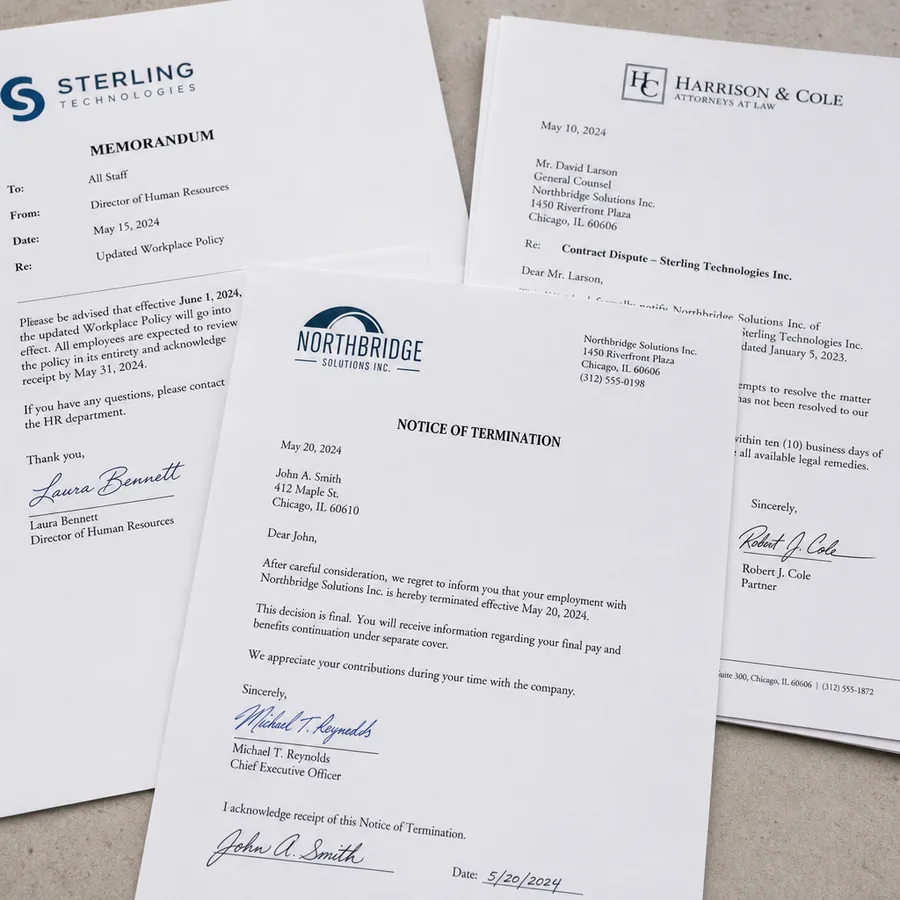
Not every employee's statement binds the company. The statement must concern a matter within the scope of the person's employment under Rule 801(d)(2)(D).
Typical authorized agents whose statements bind the employer:
- HR Directors: Statements about hiring, firing, policies, personnel decisions
- General Counsel: Statements about what records exist, what policies apply, legal positions
- Direct Supervisors: Statements about your performance, the reasons for your termination, what they observed
- Corporate Officers: Statements about company practices, decision-making processes
- Designated Representatives: Anyone the company designates to respond to unemployment claims, EEOC charges, or discovery requests
The critical point from Mahlandt: The person doesn't need authority to legally bind the company. They don't need personal knowledge of the underlying facts. They just need to be speaking about a matter within their job responsibilities.
An HR director who drafts a termination letter is speaking within the scope of employment even if they personally didn't witness the events they're describing.
What Happens When Admissions Conflict With Witness Testimony
Sometimes an earlier admission contradicts what a witness later says at deposition or trial.
The termination letter (signed by HR) says "terminated for violating confidentiality policy." At deposition, your former manager testifies "I decided to terminate her because she wasn't a team player, not because of any specific policy violation."
Both statements are evidence. The termination letter is an admission under Rule 801(d)(2)(D). The deposition testimony is also evidence. The fact-finder must decide which to credit — but the existence of the contradiction itself supports a pretext inference.
Why? Because legitimate, honestly-held reasons typically don't shift depending on who's asked or when they're asked. Contradictory explanations suggest the stated reasons are post-hoc rationalizations rather than the true motivation.
Practical Implications When Content Goes Viral
If you've been terminated shortly after work-related content went viral, the admission doctrine means you should preserve every statement your employer makes about the reasons:
- The termination letter or email
- Notes from the termination meeting (write them down immediately after)
- The unemployment agency determination and employer's response
- Any exit interview documentation
- Company statements to third parties (former colleagues, clients, industry contacts)
- Social media posts by company accounts addressing your departure
Each statement is potential admission evidence. Contradictions between statements become proof of pretext. Absences in the record (like missing policies or missing investigation notes) become admissions when the company states the record is complete.
The Intersection With Retaliation Claims
When your viral content addressed workplace issues — safety violations, wage practices, discrimination, harassment — your termination may constitute unlawful retaliation under various federal statutes.
The admission doctrine becomes particularly powerful in retaliation cases because temporal proximity and shifting explanations are core elements of proof.
An employer who admits the termination review was "completed" three days after your viral post cannot later claim the decision was made weeks earlier. An employer who states "we have no record of prior complaints about this employee" cannot later claim the termination was based on a pattern of complaints.
Each admission locks in a factual claim. When those claims contradict the employer's ultimate defense, they support the inference that retaliation was the true motive.
Frequently Asked Questions
Can my employer change their explanation for why I was fired?
Legally, employers can offer different explanations at different times. However, each explanation is an admission under Federal Rule of Evidence 801(d)(2)(D) when made by an authorized agent. All the explanations remain in evidence, and contradictions between them support an inference that the stated reasons are pretextual — that the real reason was something else (like retaliation for your viral content). Courts apply the framework from McDonnell Douglas Corp. v. Green, 411 U.S. 792 (1973), where shifting or contradictory reasons can demonstrate pretext.
What if HR says "no policy exists" but my manager told me there was a policy?
Both statements are evidence, but they carry different weight. If the HR director makes a formal statement that no written policy exists, that's an admission binding on the company under Rule 801(d)(2)(D) because HR directors speak within the scope of their employment on policy matters. Your manager's informal statement may also be an admission if it concerned their supervisory role. The contradiction itself is significant — it suggests the "policy violation" justification lacks a clear factual basis.
Does the admission doctrine apply to what my employer told the unemployment agency?
Yes. Statements to unemployment agencies are made by the employer's authorized representatives (typically HR or legal counsel) concerning matters within their employment scope. Under Mahlandt v. Wild Canid Survival & Research Ctr., 588 F.2d 626 (8th Cir. 1978), these statements are admissible as party-opponent admissions. If the unemployment response gives a different reason than the termination letter, both reasons are in evidence and the contradiction supports pretext.
Can the company's lawyer's statements be used against them?
Statements by company counsel concerning matters within the scope of their representation are generally admissible as admissions under Rule 801(d)(2)(D). This includes representations about what documents exist, what investigations occurred, and what the company's position is on factual questions. It typically does not include counsel's legal opinions or strategic theories. Factual representations — like "we have produced all responsive documents" — are binding admissions that close the records universe.
How soon after my content went viral does the timing become significant?
Courts recognize that close temporal proximity between protected activity and adverse employment action supports an inference of causation. While there's no bright-line rule, terminations within days or weeks of viral content that addressed workplace issues create strong proximity evidence. When your employer's own admissions establish the timeline — such as a termination letter stating the decision was made on a specific date — they cannot later dispute that temporal relationship. The closer the proximity, the stronger the inference, but the specific legal significance depends on the jurisdiction and the type of claim involved.