Coercive Severance Terms? What Your Pre-Signing Notes Can Prove
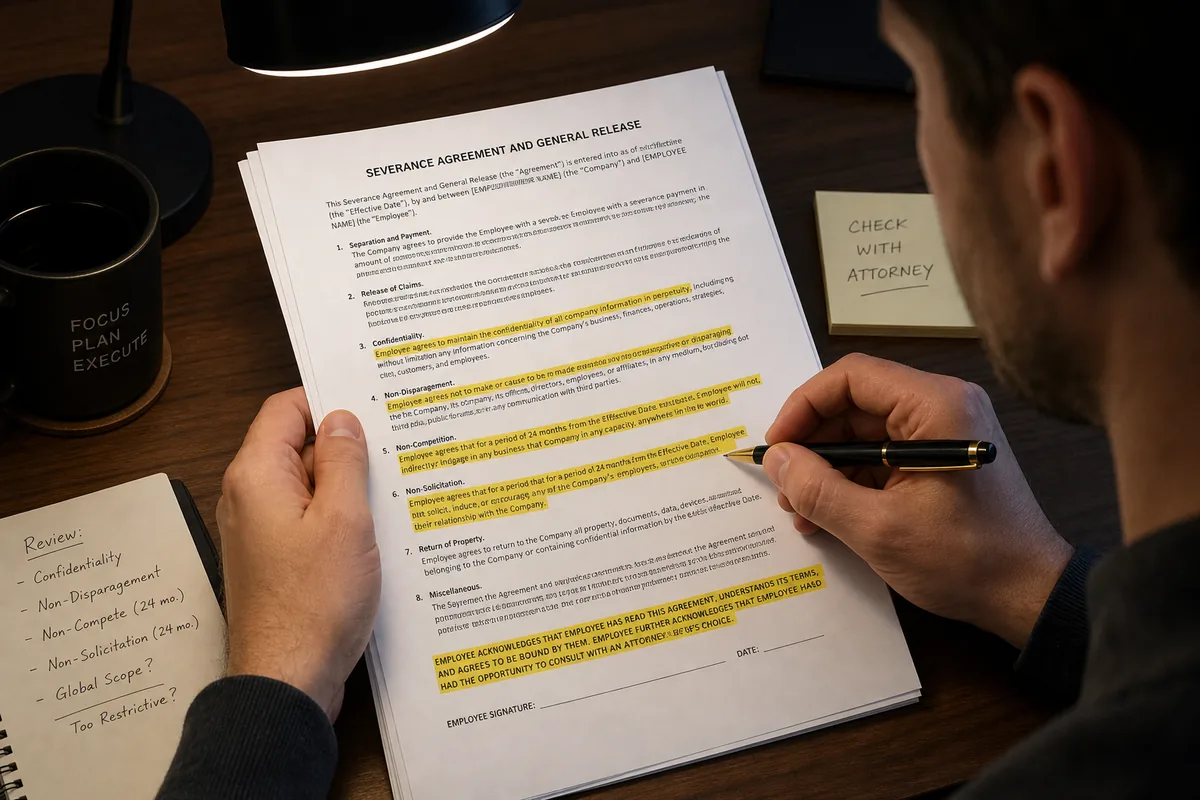
You've been handed a severance agreement with a provision that feels wrong—maybe a clawback clause you've never seen before, or a non-compete far broader than anything you signed when you started.
You hesitate. You ask questions. But eventually, pressure or economics forces your signature.
Months later, when the employer enforces that unusual term or when you challenge the circumstances that led to your separation, the company's lawyer has a ready response: "She's inventing problems now because she regrets signing."
Here's what you'll learn in this article:
- Why courts treat statements made before signing differently from complaints raised after you regret a deal
- How the Supreme Court's timing rule in Tome v. United States turns contemporaneous questions into powerful evidence
- What types of pre-signing documentation survive the "recent fabrication" attack
The Recent-Fabrication Problem Every Retaliation Plaintiff Faces
Employment defendants love a simple cross-examination tactic: suggest you invented your complaint only after the adverse action hurt you.
"Convenient, isn't it, that you claim the severance was coercive now—six months after you cashed the check?"
The question lands because juries know people sometimes revise history when litigation stakes are high.
Federal Rule of Evidence 801(d)(1)(B) offers a solution: a prior consistent statement—something you said earlier that matches your current testimony—can be admitted as substantive evidence (not just to rehabilitate credibility) if it was made before the alleged motive to lie arose.
Tome's Temporal Requirement: Before the Motive Arose

In Tome v. United States, 513 U.S. 150 (1995), the Supreme Court resolved a circuit split about timing.
The question: can a witness's earlier statement be used as evidence if it was made after the motive to fabricate existed, but before the current proceeding?
The Court said no.
Rule 801(d)(1)(B) embodies the common-law temporal rule: the prior consistent statement is admissible substantively only if made before the alleged improper influence or motive to fabricate arose.
Why? Because a statement made after you had reason to shade the truth doesn't rebut the charge that you're shading the truth—it just shows consistency in your chosen narrative.
Here's the thing:
The "motive to fabricate" clock starts when you have a reason to misrepresent facts to serve your interest.
In the severance context, that clock often starts the moment the employer presents the agreement.
Once the offer is on the table, you have a motive to justify signing (if you do sign) or to construct a coercion defense (if you challenge it later).
Statements made during the review period—questions, objections, requests for clarification sent to the company or to neutral third parties—predate that retrospective motive.
What Counts as a Prior Consistent Statement in Severance Cases
Not all pre-signing documentation carries equal weight.
Courts distinguish between statements made in the regular course of events and those created with an eye toward future litigation.
Business Records vs. Litigation Prep
In Palmer v. Hoffman, 318 U.S. 109 (1943), the Supreme Court held that accident reports prepared primarily for litigation are not "made in the regular course of business" under the business-records hearsay exception—even if the business routinely creates such reports.
The same principle applies in reverse when you create records.
A diary entry titled "Notes for my future lawsuit" will be attacked as self-serving.
But an email to your spouse, a question to the HR representative, or a contemporaneous calendar note about "felt pressured in meeting w/ Legal today" carries more weight because it wasn't created primarily to build a case.
Now, here's where it gets interesting:
Third-party recipients make your pre-signing statements nearly bulletproof.
When you send an email to HR, copy your personal account with a question about an unusual term, or mention your concern to a colleague in a Slack thread the employer preserves, you've created a timestamped, third-party-witnessed record.
The employer can't argue you backdated it. The neutral recipient (especially if it's the company's own system) removes any suggestion you fabricated the concern later.
Unusual Terms That Trigger Pre-Signing Documentation
Certain severance provisions commonly raise employee eyebrows—and should trigger contemporaneous questions.
Clawback Clauses
A clawback allows the employer to reclaim severance pay if you violate specified terms (often non-disparagement or confidentiality).
When the clawback is tied to subjective employer judgments ("if Company determines in its sole discretion that you have disparaged us"), employees often sense the one-sided risk.
An email before signing—"This clawback language seems to let you take back my severance for almost any reason. Is that standard?"—becomes evidence that you perceived coercion or imbalance at the time.
Unusually Broad Non-Competes
If you've worked for the company for fifteen years without a non-compete, and the severance suddenly includes a two-year, nationwide restriction, that discontinuity is itself evidence of coercion.
But only if you noted it contemporaneously.
A pre-signing question—"I never had a non-compete before. Why is this required now, and what happens if I don't sign?"—documents that the new term wasn't part of your ordinary employment relationship.
Here's what this looks like in practice:
Imagine you're presented with a severance after twenty years of service.
The agreement includes a provision requiring you to cooperate in any future litigation "at Company's expense" but defines "cooperation" to include unlimited unpaid time.
You send an email to HR: "Does 'cooperation' mean I have to fly back for depositions on my own time? I'm planning to relocate out of state."
Six months later, the company subpoenas you for a week-long trial preparation. You object, citing hardship.
The company argues you agreed to unlimited cooperation.
Your pre-signing email—expressing concern about the scope of "cooperation" before you ever signed—rebuts any claim that you understood and accepted the term as the company now interprets it.
Where to Send Pre-Signing Questions (and Why It Matters)

The recipient of your pre-signing statement affects both admissibility and persuasive weight.
To the Employer
Emails or voicemails to HR, in-house counsel, or your manager serve dual purposes.
First, they create a record the employer cannot dispute (it's in their own files).
Second, if the employer's response is evasive, contradictory, or threatening, that response may itself be admissible as a party-opponent admission.
To Neutral Third Parties
Statements to a personal attorney, an employment agency, a regulatory hotline, or even a family member (if documented) carry independent credibility because the recipient had no stake in shading your perception.
A contemporaneous consultation with an employment lawyer—even if you didn't retain them—creates a privileged but timestamped record of your concerns.
To Yourself (with Caution)
Diary entries, personal emails to your own non-work account, or calendar notes can serve as prior consistent statements, but they're easier to attack because you control the creation and preservation.
Courts are more skeptical of purely self-generated records unless they're corroborated by external evidence (like a reply from HR confirming receipt of your question).
But it gets better:
When your pre-signing statement goes to a government agency or regulatory body, it often qualifies under multiple hearsay exceptions.
A complaint to the EEOC, a question submitted to a state labor board's hotline, or a report to OSHA—all made before you signed the severance—can be admitted both as prior consistent statements under 801(d)(1)(B) and as public records under 803(8), depending on the context.
Common Mistakes That Undermine Pre-Signing Evidence
Even well-documented concerns can lose evidentiary value if created or preserved improperly.
Mistake 1: Waiting Until After You've Signed
An email sent the day after you execute the severance, saying "I had serious concerns about that clawback clause," is worthless under Tome.
By the time you've signed, the motive to justify your decision (or to build a later challenge) has fully ripened.
Mistake 2: Only Complaining Verbally
Undocumented hallway conversations or phone calls are nearly impossible to prove later.
Without a contemporaneous written record, it becomes your word against the employer's about what was said and when.
Mistake 3: Editorializing Retroactively
Adding explanatory notes to old emails, highlighting passages in printed severance agreements after the fact, or creating "summary timelines" months later all invite the fabrication challenge Tome is designed to avoid.
The record must be contemporaneous and unaltered.
How Courts Apply Tome in Severance-Coercion Cases
When an employee claims a severance agreement was signed under duress, coercion, or without knowing waiver of statutory rights, the employer's first move is to argue that the complaint is post-hoc rationalization.
"She took the money. She signed the release. Now she's invented problems to get out of the deal."
Tome provides the framework to defeat that argument—but only if the plaintiff preserved evidence before signing.
Timing Is Everything
The question courts ask: when did the alleged motive to fabricate arise?
If the employee claims the severance was presented on a "sign today or be terminated" basis, any statement made before that ultimatum carries weight.
If the employee had weeks to review the agreement with counsel, the motive-to-fabricate analysis becomes more nuanced—but pre-signing questions still matter, because they show the employee's concerns were genuine and contemporaneous, not invented after economic consequences became clear.
Here's the thing:
Even when the employee ultimately signs, pre-signing objections can establish lack of voluntary, knowing consent.
Courts in ADEA waiver cases, for instance, require that releases be "knowing and voluntary."
Evidence that the employee raised unresolved questions about scope, asked for clarification the employer refused to provide, or noted pressure to sign quickly all support a finding that the waiver was not knowing—even if the signature appears on the agreement.
Building a Pre-Signing Record Without Sabotaging Negotiation
You might worry that asking too many questions or voicing concerns will cause the employer to withdraw the severance offer.
That's a legitimate economic concern, but the legal calculus is different.
Questions Are Not Refusals
Asking "Can you explain why this non-compete is broader than the one in my original employment agreement?" is not the same as refusing to sign.
It's a request for clarification—entirely appropriate during a review period the employer is legally required to provide in many contexts (like ADEA waivers, which mandate 21 or 45 days depending on the circumstance).
Documenting Responses
When you ask a question in a meeting, follow up with an email: "Thanks for discussing the clawback clause today. Just to confirm, you said [X]. Is that correct?"
If the employer replies, you have their interpretation on the record.
If they don't reply, their silence after your contemporaneous question becomes evidence that your concern was never resolved.
Now, here's where it gets interesting:
Employers sometimes respond to pre-signing questions with statements that later contradict their litigation position.
In Castro v. Local 1199, Nat'l Health & Human Servs. Emps. Union, 964 F. Supp. 719 (S.D.N.Y. 1997), internal HR statements about an employee's status were admitted as party-opponent admissions when they contradicted the employer's defense at summary judgment.
An HR email saying "This clawback is standard; we'd never actually enforce it for minor complaints" can later be used against the employer if they do claw back your severance over a neutral LinkedIn post.
What Happens When You Don't Preserve Pre-Signing Concerns
Failing to document contemporaneous questions doesn't automatically doom a later challenge—but it makes proof much harder.
You'll be forced to rely on your own testimony about what you thought and felt at the time.
Without corroboration, that testimony is vulnerable to the exact "recent fabrication" attack Tome is designed to prevent.
In practical terms, cases without pre-signing documentation often turn on credibility contests at trial—expensive, uncertain, and avoidable with simple contemporaneous records.
Practical Steps: Creating a Pre-Signing Record
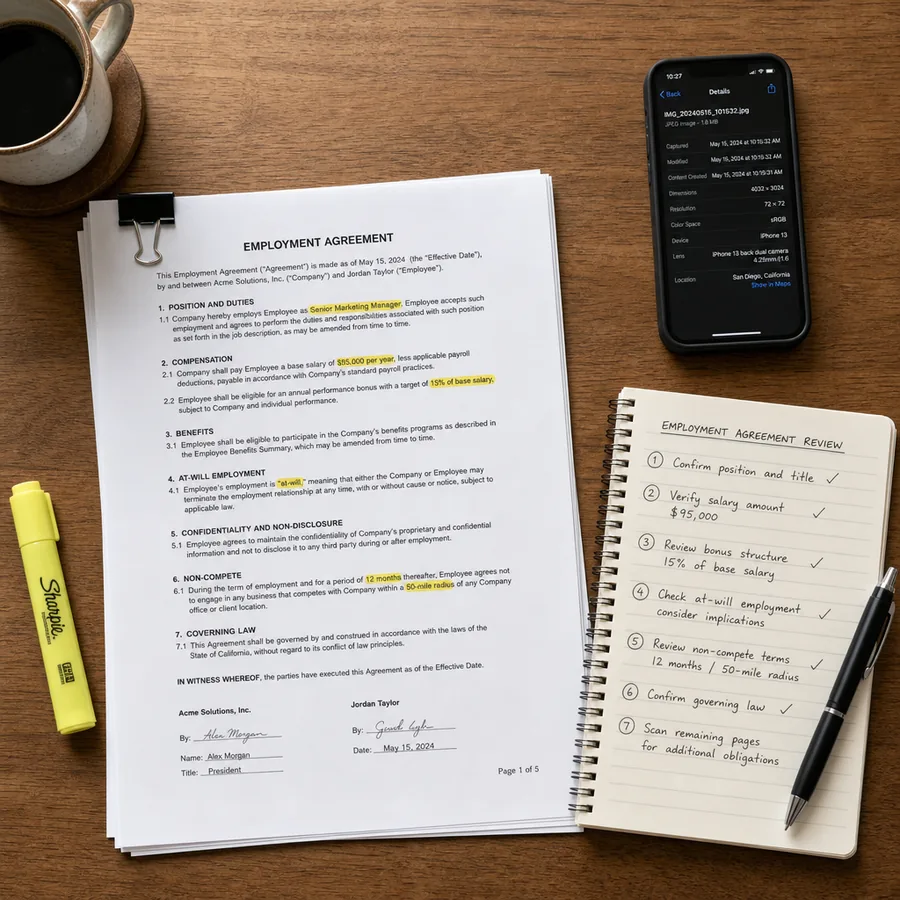
You don't need to be a lawyer to preserve admissible evidence of your contemporaneous concerns.
Step 1: Read Before the Deadline Pressure Hits
Don't wait until the last day of your review period.
Read the severance agreement as soon as you receive it, while you still have time to ask questions without appearing to stall.
Step 2: Note Every Unusual or Unclear Term
Circle or highlight provisions that differ from your existing employment terms, that use vague language, or that impose obligations you didn't expect.
Common examples: non-competes you never had before, confidentiality clauses broader than your employee handbook, indemnification provisions, mandatory arbitration with fee-shifting.
Step 3: Ask in Writing
Send your questions to HR or the company contact by email.
Use your personal email account (BCC'd or forwarded to yourself) so you retain a copy independent of company systems.
Be specific: "Section 4(b) requires me to notify the Company before accepting any employment for two years. Does that include freelance work or volunteer board positions?"
Step 4: Document Non-Responses
If the employer doesn't answer, send a follow-up: "I haven't heard back about my question regarding Section 4(b). Can you clarify before the review period ends?"
If they still don't respond, you've established that you raised the concern and the employer chose not to resolve it.
Step 5: Consult a Third Party
Even a single consultation with an employment attorney creates a timestamped record (the attorney's intake notes or engagement letter, if any) showing you had concerns serious enough to seek outside advice.
The consultation itself may be privileged, but the fact of the consultation and its timing are not.
The Intersection of Tome and ADEA Waiver Validity
The Older Workers Benefit Protection Act (OWBPA) imposes specific requirements for valid ADEA waivers in severance agreements.
One requirement: the waiver must be "knowing and voluntary."
Pre-signing questions and concerns—preserved under Tome's timing rule—become direct evidence that the waiver was not knowing.
If you asked what "all claims" meant and received no answer, or if you questioned whether the release covered future retaliation and were told "just sign it," those contemporaneous records support a finding that you didn't knowingly waive statutory rights.
The employer can't later claim the release was clear and you understood it, when their own files contain your unanswered questions.
Frequently Asked Questions
Does emailing myself with concerns about the severance agreement create admissible evidence?
Self-sent emails can serve as prior consistent statements under Tome if they predate the motive to fabricate, but courts view them more skeptically than emails to third parties because you control creation and preservation. Stronger evidence includes emails to HR, the employer's attorney, or a neutral third party like your own lawyer or a family member, all of which provide independent corroboration of timing.
What if I asked questions verbally in a meeting but didn't follow up in writing?
Verbal questions are difficult to prove later because they become credibility contests—your recollection against the employer's. Without a written record, you lose the independent timestamp that makes Tome prior consistent statements powerful. If you raised concerns in a meeting, send a confirmation email afterward summarizing what was discussed to create a contemporaneous written record.
Can the employer refuse to answer my questions about the severance agreement?
The employer has no general legal obligation to answer every question, but their silence can be used as evidence. If you asked specific questions in writing about ambiguous or unusual terms and the employer chose not to clarify, that non-response supports a later argument that the agreement was not the product of informed, knowing consent—particularly in ADEA waiver cases where courts scrutinize whether the employee understood what rights were being released.
How soon before signing do I need to document concerns for them to count under Tome?
The Tome rule requires only that the statement predate the motive to fabricate—not that it be made weeks in advance. A question sent the day before you sign still qualifies as a prior consistent statement because it was made before you had reason to justify signing or to invent post-hoc objections. The key is that the concern was raised before the agreement was executed, not after you experienced adverse consequences from its terms.
What if I signed the severance agreement but my pre-signing emails show I didn't understand key terms?
Pre-signing questions that went unanswered, or that received misleading responses, can be used to challenge the validity of the release. In cases involving statutory waivers (like ADEA claims), courts require that the waiver be "knowing and voluntary." Evidence that you raised unresolved questions about scope, asked for clarification the employer didn't provide, or received assurances that later proved false all support a finding that your signature was not the product of informed consent, even though it appears on the agreement.