Burlington v. White: The Materially-Adverse Standard, Explained

You reported discrimination at work. Two weeks later, your manager switched your shift, moved your desk, or pulled you from a project team.
Is that retaliation? Or just business as usual?
The 2006 Supreme Court case Burlington Northern & Santa Fe Railway Co. v. White answered that question—and set the bar for what counts as "materially adverse" in every federal retaliation case since.
What Happened in Burlington Northern v. White
Sheila White was the only woman working in the maintenance-of-way department at a Tennessee railroad yard.
She operated a forklift—a coveted assignment because it was cleaner and more interesting than the manual track-labor jobs.
After she complained about her supervisor's sexual harassment, Burlington Northern removed her from forklift duty and reassigned her to standard track work.
The company later suspended her without pay for 37 days. (She was reinstated with back pay after she was found not at fault.)
White sued, claiming the reassignment and suspension were retaliation for her discrimination complaint.
The Supreme Court's Two-Part Holding
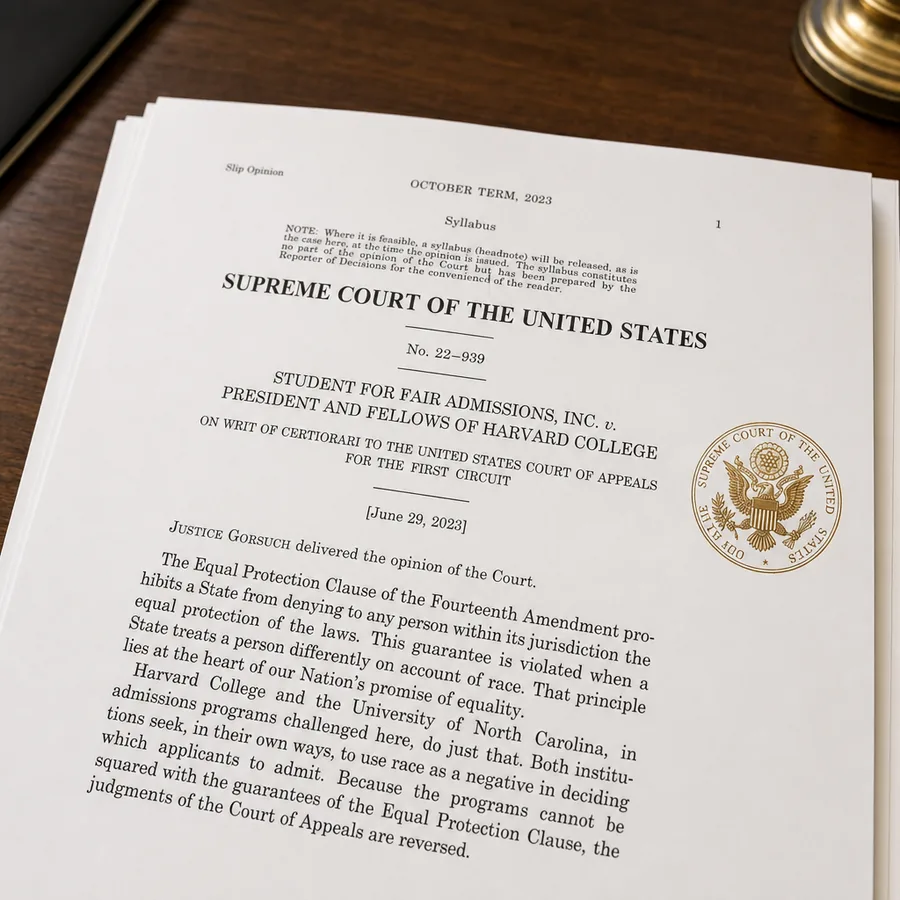
The Supreme Court ruled in White's favor and clarified two critical points about retaliation law.
1. Retaliation Covers More Than Just Hiring and Firing
Title VII's anti-retaliation provision is broader than its anti-discrimination provision.
To prove discrimination, you must show the employer took action affecting the "terms, conditions, or privileges of employment"—things like pay, promotions, or job duties.
But retaliation law doesn't use that language. It forbids an employer from discriminating against an employee because the employee "opposed" discrimination or "made a charge" under Title VII.
The Court held that retaliation claims are not limited to workplace-related harms.
An employer can retaliate in ways that don't show up on a W-2 or affect the "terms and conditions" of employment.
2. The "Materially Adverse" Test
The Court created a new standard: an action is retaliatory if a reasonable employee "would have found the challenged action materially adverse"—meaning it "might well have dissuaded a reasonable worker from making or supporting a charge of discrimination."
That's the test. Not "would it harm the employee?" but "would it deter future complaints?"
If the answer is yes, the action is materially adverse.
Here's the Thing: What "Materially Adverse" Really Means
The phrase "materially adverse" sounds technical. It's not.
It's a deterrence test, framed from the perspective of a hypothetical reasonable employee.
Would a reasonable person in your shoes think twice before complaining—if they knew this kind of action might follow?
If yes, the action is materially adverse.
What Counts
Courts have found the following actions materially adverse under Burlington:
- Reassignment from forklift operator to track laborer (the original Burlington facts)
- A 37-day unpaid suspension, even if followed by reinstatement with back pay
- Removal from a high-visibility project team
- Transfer to a less desirable shift or location, even at the same pay
- Exclusion from meetings or communications the employee previously attended
- Mandatory "performance improvement plans" not applied to similarly situated employees
What Doesn't Count
The Court was explicit: "petty slights or minor annoyances" don't meet the standard.
Examples courts have rejected:
- A single negative performance review, if not accompanied by other consequences
- A change in supervisor, without evidence the new supervisor was harder to work with
- Temporary (1-2 week) shift swaps that were later reversed
- Being asked to justify work decisions in writing (if that was standard practice for others)
Now, Here's Where It Gets Interesting: The Numbers
Why?
Because Burlington lowered the bar. It removed the requirement that retaliation affect "terms and conditions of employment" and replaced it with a deterrence-focused standard.
If you can show the employer's action would make a reasonable person think twice before complaining, you've met your burden.
Combining Burlington with Temporal Proximity
The Burlington standard defines what counts as retaliation.
But you still need to prove why the employer took the action—specifically, that it was because you engaged in protected activity.
That's where temporal proximity comes in.
If the adverse action happened very close in time to your complaint, courts treat that timing as evidence of retaliatory motive.
In Mickey v. Zeidler Tool & Die Co., 516 F.3d 516 (6th Cir. 2008), the Sixth Circuit held that when an adverse action occurs "very close in time" after an employer learns of protected activity, that proximity alone is "significant enough to constitute evidence of a causal connection" for a prima facie retaliation case.
How close is "very close"?
Courts have found 48 hours sufficient. Some circuits accept intervals measured in days or a few weeks. (For more detail, see our breakdown of Clark County v. Breeden: How Close Must Temporal Proximity Be?.)
What Burlington Doesn't Cover
The Burlington standard applies to Title VII retaliation claims.
It has been adopted—either explicitly or by analogy—in most other federal employment statutes, including:
- Section 1981 (though §1981 also requires "but-for" causation; see Comcast v. NAAAOM: But-For Causation Under §1981)
- FLSA anti-retaliation provisions
- OSHA whistleblower protections
- Sarbanes-Oxley and Dodd-Frank retaliation claims
But Burlington does not define what counts as an "adverse employment action" for discrimination claims (as opposed to retaliation claims).
Discrimination claims still require proof that the employer's action affected the terms, conditions, or privileges of employment.
But It Gets Better: How Courts Apply This in Practice

Judges don't apply Burlington in a vacuum. They look at context.
Here's what matters:
The Nature of the Job
A shift change may be materially adverse for a parent balancing childcare—but trivial for a single worker with flexible hours.
A reassignment from forklift to track labor was materially adverse for Sheila White because track labor was harder, dirtier, and less desirable.
A lateral transfer between two equivalent desk jobs? Probably not.
The Employee's Prior Work History
If you've worked the same assignment for years and are suddenly moved after complaining, that's a red flag.
If assignments rotate regularly and your move was already scheduled, the employer has an easier defense.
How the Employer Treated Similarly Situated Employees
Were other employees subjected to the same action for the same reasons?
If yes, it's harder to prove the action was retaliatory.
If no—if only you were reassigned, excluded, or put on a performance plan—the inference of retaliation strengthens.
Common Misconceptions About Burlington
Misconception 1: You need to prove financial harm.
No. Burlington explicitly rejected that requirement. The test is deterrence, not damages.
Misconception 2: Any negative action after a complaint is retaliation.
No. The action must be "materially adverse"—petty slights and minor annoyances don't count, even if they're unpleasant.
Misconception 3: You need direct evidence the employer intended to retaliate.
No. You need to show the adverse action would deter complaints and that it occurred because of your protected activity. Timing alone can satisfy the causation element at the prima facie stage.
The Bottom Line
Burlington Northern v. White expanded the scope of what counts as retaliation under federal law.
The Supreme Court made clear that retaliation is not limited to firings, demotions, or pay cuts.
Any action that would deter a reasonable employee from complaining about discrimination can qualify—even if it doesn't affect the "terms and conditions of employment."
And when that action follows protected activity by a matter of days or weeks, courts treat the timing itself as evidence of retaliatory intent.
That combination—materially adverse + temporal proximity—has helped plaintiffs survive summary judgment in nearly two-thirds of tracked cases.
Frequently Asked Questions
Does Burlington apply to retaliation claims under state law?
Most state courts have adopted the Burlington standard or a functionally identical test for state-law retaliation claims. A few states use narrower definitions tied to "adverse employment actions," so the specific statute and jurisdiction matter.
Can an action be materially adverse even if I wasn't fired or suspended?
Yes. The Supreme Court held that retaliation is not limited to actions affecting pay, job title, or employment status. Reassignments, exclusions, shift changes, and even non-workplace actions (like blacklisting) can be materially adverse if they would deter complaints.
How much time between my complaint and the adverse action is "too much" to show retaliation?
Burlington doesn't set a specific time limit. Courts evaluate temporal proximity on a case-by-case basis. Intervals of 48 hours to a few weeks are often found sufficient; gaps of many months typically require additional evidence of retaliatory motive.
What if my employer says the action was for a legitimate business reason?
Once you establish a prima facie case (materially adverse action + causal connection to protected activity), the burden shifts to the employer to offer a legitimate, non-retaliatory reason. If they do, you then have the opportunity to show that reason is pretextual—a cover story for retaliation.
Does Burlington apply to whistleblower retaliation under Sarbanes-Oxley or Dodd-Frank?
Yes, by analogy. Courts applying SOX, Dodd-Frank, and similar whistleblower statutes typically borrow the Burlington "materially adverse" standard, though the specific statutory language and implementing regulations may add further requirements.